


Page 37 - (DK Eyewitness) Travel Guide - England's South Coast
P. 37
THE HIST OR Y OF ENGLAND ’ S SOUTH C O AST 35
the decisive Battle of Edington in Wiltshire
under its most celebrated king, Alfred the
Great. Alfred’s grandson, Athelstan, became
the first king of a united England in 937.
Norman Invaders
Harold II was the last Anglo-Saxon king of
England, but his claim to the throne was
disputed by William of Normandy, who
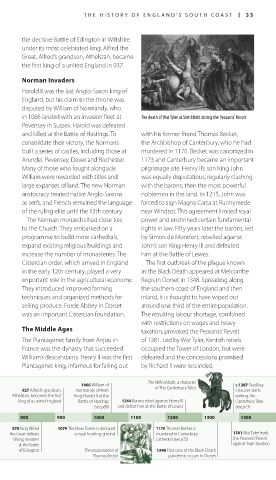
in 1066 landed with an invasion fleet at The death of Wat Tyler at Smithfield during the Peasants’ Revolt
Pevensey in Sussex. Harold was defeated
and killed at the Battle of Hastings. To with his former friend Thomas Becket,
consolidate their victory, the Normans the Archbishop of Canterbury, who he had
built a series of castles, including those at murdered in 1170. Becket was canonized in
Arundel, Pevensey, Dover and Rochester. 1173 and Canterbury became an important
Many of those who fought alongside pilgrimage site. Henry II’s son King John
William were rewarded with titles and was equally disputatious, regularly clashing
large expanses of land. The new Norman with the barons, then the most powerful
aristocracy treated native Anglo-Saxons noblemen in the land. In 1215, John was
as serfs, and French remained the language forced to sign Magna Carta at Runnymede
of the ruling elite until the 13th century. near Windsor. This agreement limited royal
The Norman monarchs had close ties power and enshrined certain fundamental
to the Church. They embarked on a rights in law. Fifty years later the barons, led
programme to build more cathedrals, by Simon de Montfort, rebelled against
expand existing religious buildings and John’s son King Henry III and defeated
increase the number of monasteries. The him at the Battle of Lewes.
Cistercian order, which arrived in England The first outbreak of the plague known
in the early 12th century, played a very as the Black Death appeared at Melcombe
important role in the agricultural economy. Regis in Dorset in 1348. Spreading along
They introduced improved farming the southern coast of England and then
techniques and organized methods for inland, it is thought to have wiped out
selling produce. Forde Abbey in Dorset around one third of the entire population.
was an important Cistercian foundation. The resulting labour shortage, combined
with restrictions on wages and heavy
The Middle Ages taxation, provoked the Peasants’ Revolt
The Plantagenet family from Anjou in of 1381. Led by Wat Tyler, Kentish rebels
France was the dynasty that succeeded occupied the Tower of London, but were
William’s descendants. Henry II was the first defeated and the concessions promised
Plantagenet king, infamous for falling out by Richard II were rescinded.
The Wife of Bath, a character
1066 William of c.1387 Geoffrey
927 Alfred’s grandson, Normandy defeats in The Canterbury Tales Chaucer starts
597 St Augustine is sent Athelstan, becomes the first King Harold II at the writing The
to Kent by the pope as a king of a united England Battle of Hastings 1264 Barons rebel against Henry III Canterbury Tales
missionary to the English (see p80) and defeat him at the Battle of Lewes (see p73)
600 700 800 900 1000 1100 1200 1300 1400
878 King Alfred 1079 The New Forest is declared 1170 Thomas Becket is
the Great defeats a royal hunting ground murdered in Canterbury 1381 Wat Tyler leads
Viking invaders Cathedral (see p72) the Peasants’ Revolt
at the Battle against high taxation
of Edington The assassination of 1348 First case of the Black Death
Thomas Becket pandemic occurs in Dorset
032-037_EW_ESC.indd 35 10/03/17 6:51 pm

