


Page 36 - (DK Eyewitness) Travel Guide - England's South Coast
P. 36
34 INTRODUCING ENGLAND ’ S SOUTH C O AST
Roman Rule another set of invaders arrived: these
In AD 43, Emperor Claudius sent a were Germanic tribes from Western
Roman fleet carrying 40,000 troops Europe, collectively known as
to Richborough, in Kent, on the Anglo-Saxons. Jutes occupied
pretext of intervening in a Kent and the Isle of Wight
dispute between two warring and Saxons controlled Sussex
tribes. The Catuvellauni, under before spreading westwards.
their leader Caratacus, resisted The Anglo-Saxons were pagans
but were defeated near the River but gradually a succession of
Medway in Kent. The Roman kings converted to Christianity.
general Vespasian then headed In 597, Pope Gregory sent monks
west, only encountering any real to Kent, led by St Augustine,
opposition from the Durotriges who established a cathedral at
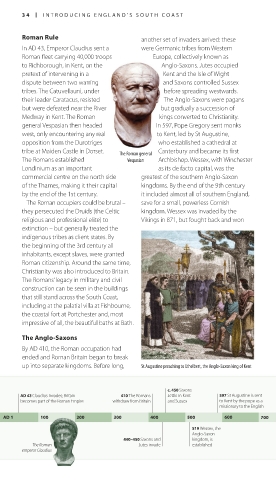
tribe at Maiden Castle in Dorset. The Roman general Canterbury and became its first
The Romans established Vespasian Archbishop. Wessex, with Winchester
Londinium as an important as its de facto capital, was the
commercial centre on the north side greatest of the southern Anglo-Saxon
of the Thames, making it their capital kingdoms. By the end of the 9th century
by the end of the 1st century. it included almost all of southern England,
The Roman occupiers could be brutal – save for a small, powerless Cornish
they persecuted the Druids (the Celtic kingdom. Wessex was invaded by the
religious and professional elite) to Vikings in 871, but fought back and won
extinction – but generally treated the
indigenous tribes as client states. By
the beginning of the 3rd century all
inhabitants, except slaves, were granted
Roman citizenship. Around the same time,
Christianity was also introduced to Britain.
The Romans’ legacy in military and civil
construction can be seen in the buildings
that still stand across the South Coast,
including at the palatial villa at Fishbourne,
the coastal fort at Portchester and, most
impressive of all, the beautiful baths at Bath.
The Anglo-Saxons
By AD 410, the Roman occupation had
ended and Roman Britain began to break
up into separate kingdoms. Before long, St Augustine preaching to Ethelbert, the Anglo-Saxon king of Kent
c. 450 Saxons 927 Alfred’s grandson,
AD 43 Claudius invades; Britain 410 The Romans settle in Kent 597 St Augustine is sent Athelstan, becomes the first
becomes part of the Roman Empire withdraw from Britain and Sussex to Kent by the pope as a king of a united England
missionary to the English
AD 1 100 200 300 400 500 600 700
519 Wessex, the 878 King Alfred
Anglo-Saxon the Great defeats
440–450 Saxons and kingdom, is Viking invaders
The Roman Jutes invade established at the Battle
emperor Claudius of Edington
032-037_EW_ESC.indd 34 10/03/17 6:51 pm

