


Page 34 - World of Animals - Issue #31
P. 34
Lord of the fl ies


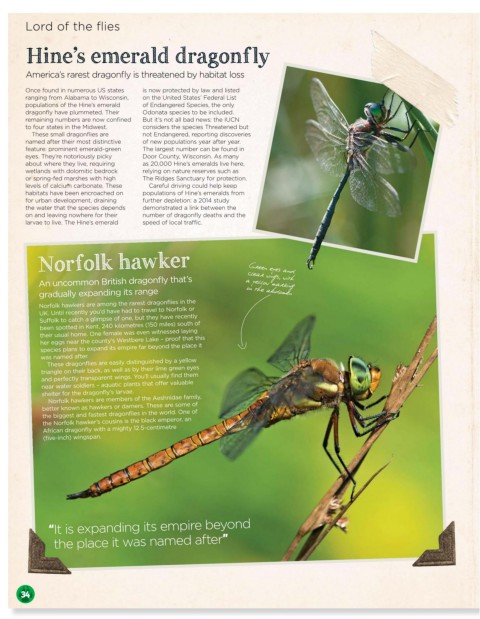
            Hine’s emerald dragonfly


            America’s rarest dragonfly is threatened by habitat loss

            Once found in numerous US states   is now protected by law and listed
            ranging from Alabama to Wisconsin,   on the United States’ Federal List
            populations of the Hine’s emerald   of Endangered Species, the only
            dragonfly have plummeted. Their   Odonata species to be included.


            remaining numbers are now confined   But it’s not all bad news: the IUCN
            to four states in the Midwest.  considers the species Threatened but

              These small dragonflies are    not Endangered, reporting discoveries
            named after their most distinctive   of new populations year after year.
            feature: prominent emerald-green   The largest number can be found in
            eyes. They’re notoriously picky   Door County, Wisconsin. As many
            about where they live, requiring   as 20,000 Hine’s emeralds live here,
            wetlands with dolomitic bedrock   relying on nature reserves such as
            or spring-fed marshes with high   The Ridges Sanctuary for protection.
            levels of calcium carbonate. These   Careful driving could help keep
            habitats have been encroached on   populations of Hine’s emeralds from
            for urban development, draining   further depletion: a 2014 study
            the water that the species depends   demonstrated a link between the
            on and leaving nowhere for their   number of dragonfly deaths and the

            larvae to live. The Hine’s emerald   speed of local traffic.


               Norf olk hawker                                           Green eyes and


                An uncommon British dragonfl  y that’s                   a yellow marking
                An uncommon British dragonfl  y that’s
                                                                         clear wings, with
                gradually expanding its range
                gradually expanding its range                           on the abdomen
                Norfolk hawkers are among the rarest dragonfl  ies in the
                UK. Until recently you’d have had to travel to Norfolk or
                Suffolk to catch a glimpse of one, but they have recently
                been spotted in Kent, 240 kilometres (150 miles) south of
                their usual home. One female was even witnessed laying
                her eggs near the county’s Westbere Lake – proof that this
                species plans to expand its empire far beyond the place it
                was named after.
                  These dragonfl  ies are easily distinguished by a yellow
                triangle on their back, as well as by their lime green eyes
                and perfectly transparent wings. You’ll usually fi  nd them
                near water soldiers – aquatic plants that offer valuable
                shelter for the dragonfl  y’s larvae.
                  Norfolk hawkers are members of the Aeshnidae family,
                 better known as hawkers or darners. These are some of
                 the biggest and fastest dragonfl  ies in the world. One of
                 the Norfolk hawker’s cousins is the black emperor, an
                 African dragonfl  y with a mighty 12.5-centimetre
                 (fi  ve-inch) wingspan.


                  “It is expanding its empire beyond

                    the place it was named after”


           34


       032-038_DamselsinDistress.indd   34                                                                                   02/03/2016   17:11

