


Page 67 - World of Animals - Issue #31
P. 67
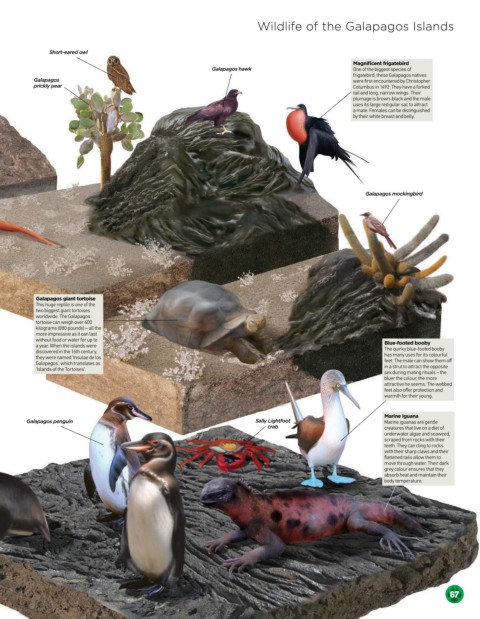
Wildlife of the Galapagos Islands


                  Short-eared owl
                                                                                                     Magnificent frigatebird

                                                               Galapagos hawk                        One of the biggest species of
                                                                                                     frigatebird, these Galapagos natives
              Galapagos                                                                              were first encountered by Christopher

              prickly pear                                                                           Columbus in 1492. They have a forked
                                                                                                     tail and long, narrow wings. Their
                                                                                                     plumage is brown-black and the male
                                                                                                     uses its large red gular sac to attract
                                                                                                     a mate. Females can be distinguished
                                                                                                     by their white breast and belly.


                                                                                                         Galapagos mockingbird


               Galapagos giant tortoise
               This huge reptile is one of the
               two biggest giant tortoises
               worldwide. The Galapagos
               tortoise can weigh over 400
               kilograms (880 pounds) – all the
               more impressive as it can last
               without food or water for up to
               a year. When the islands were                                                                  Blue-footed booby
               discovered in the 16th century,                                                                The quirky blue-footed booby
               they were named ‘Insulae de los                                                                has many uses for its colourful
               Galopegos’, which translates as                                                                feet. The male can show them off
               ‘Islands of the Tortoises’.                                                                    in a strut to attract the opposite
                                                                                                              sex during mating rituals – the
                                                                                                              bluer the colour, the more
                                                                                                              attractive he seems. The webbed
                                                                                                              feet also offer protection and

                                                                                                              warmth for their young.
                                                                                                              Marine iguana
            Galapagos penguin                                              Sally Lightfoot                    Marine iguanas are gentle
                                                                              crab                            creatures that live on a diet of
                                                                                                              underwater algae and seaweed,
                                                                                                              scraped from rocks with their
                                                                                                              teeth. They can cling to rocks
                                                                                                              with their sharp claws and their

                                                                                                              flattened tails allow them to
                                                                                                              move through water. Their dark
                                                                                                              grey colour ensures that they
                                                                                                              absorb heat and maintain their
                                                                                                              body temperature.


                                                                                                                               67


       064-069_WildlifeofGalapagosKS_WOA31.indd   67                                                                         02/03/2016   16:02

