


Page 68 - World of Animals - Issue #31
P. 68
Wildlife of the Galapagos Islands


                            s
                                      i
                                        s
                     n
                        d
                                in
                                          ola
              s
                la
                                                      o
                                                     i
                                                   t
            Islands in isolation
            I I s la n  d   s   in    i s ola      t i o  n
                                                          n
            “The Galapagos Islands have a unique set of environmental conditions,”
            says Holly Forsyth, PR and communications officer at the Galapagos

            Conservation Trust. “Their sunny equatorial position combined with
            their location amid the cool Humboldt and Cromwell ocean currents
            allows these special islands to display a strange mix of both tropical and
            temperate environments, which is reflected in the unusual plants and

            animals that inhabit them.”
              The Galapagos Islands boast unique and beautiful animals, including
            birds, reptiles and fish. It’s the location where naturalist and geologist

            Charles Darwin studied wildlife in great depth; he set off for a five-

            year voyage in 1831 and his findings here played a crucial part in the

            development of his theory of natural selection.
              Because of the remote location of the Galapagos, the islands have
            some of the highest levels of endemic species in the world, including
            80 per cent of the land birds, 30 per cent of the plant life, and 97 per
            cent of the reptiles and land mammals. Sadly, the wildlife is under threat
            from a number of elements including invasive species (which can cause
            infections, predation and rivalry for resources), a greater number of
            tourists, changes in climate and marine pollution.


            Island natives


            Introducing just a few of the unique island inhabitants


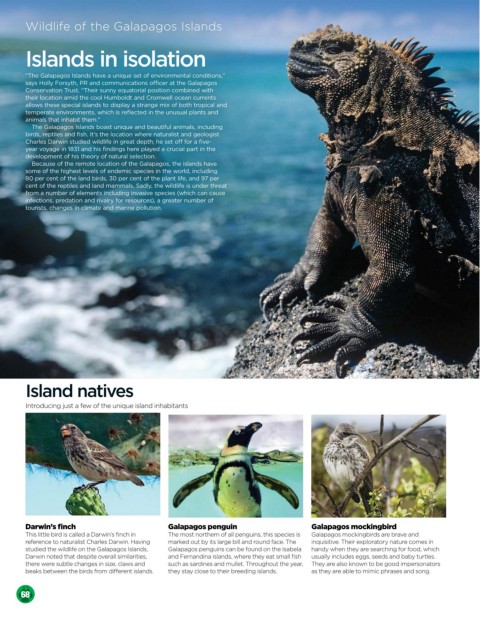
            Darwin’s fi nch                         Galapagos penguin                      Galapagos mockingbird
            This little bird is called a Darwin’s finch in   The most northern of all penguins, this species is   Galapagos mockingbirds are brave and

            reference to naturalist Charles Darwin. Having   marked out by its large bill and round face. The   inquisitive. Their exploratory nature comes in
            studied the wildlife on the Galapagos Islands,   Galapagos penguins can be found on the Isabela   handy when they are searching for food, which

            Darwin noted that despite overall similarities,   and Fernandina islands, where they eat small fish   usually includes eggs, seeds and baby turtles.
            there were subtle changes in size, claws and   such as sardines and mullet. Throughout the year,   They are also known to be good impersonators
            beaks between the birds from different islands.  they stay close to their breeding islands.  as they are able to mimic phrases and song.
           68


       064-069_WildlifeofGalapagosKS_WOA31.indd   68                                                                         02/03/2016   16:02

