


Page 69 - World of Animals - Issue #31
P. 69
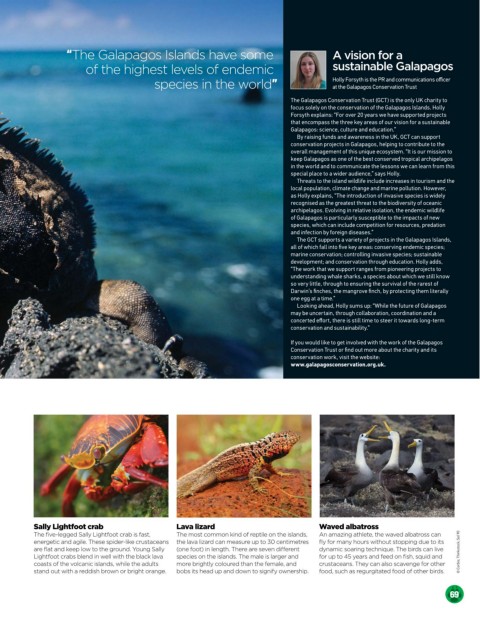
“The Galapagos Islands have some                                         A vision for a

                            of the highest levels of endemic                                    sustainable Galapagos

                                               species in the world”                            Holly Forsyth is the PR and communications offi cer
                                                                                                at the Galapagos Conservation Trust
                                                                                    The Galapagos Conservation Trust (GCT) is the only UK charity to
                                                                                    focus solely on the conservation of the Galapagos Islands. Holly
                                                                                    Forsyth explains: “For over 20 years we have supported projects
                                                                                    that encompass the three key areas of our vision for a sustainable
                                                                                    Galapagos: science, culture and education.”
                                                                                      By raising funds and awareness in the UK, GCT can support
                                                                                    conservation projects in Galapagos, helping to contribute to the
                                                                                    overall management of this unique ecosystem. “It is our mission to
                                                                                    keep Galapagos as one of the best conserved tropical archipelagos
                                                                                    in the world and to communicate the lessons we can learn from this
                                                                                    special place to a wider audience,” says Holly.
                                                                                      Threats to the island wildlife include increases in tourism and the
                                                                                    local population, climate change and marine pollution. However,
                                                                                    as Holly explains, “The introduction of invasive species is widely
                                                                                    recognised as the greatest threat to the biodiversity of oceanic
                                                                                    archipelagos. Evolving in relative isolation, the endemic wildlife
                                                                                    of Galapagos is particularly susceptible to the impacts of new
                                                                                    species, which can include competition for resources, predation
                                                                                    and infection by foreign diseases.”
                                                                                      The GCT supports a variety of projects in the Galapagos Islands,
                                                                                    all of which fall into five key areas: conserving endemic species;

                                                                                    marine conservation; controlling invasive species; sustainable
                                                                                    development; and conservation through education. Holly adds,
                                                                                    “The work that we support ranges from pioneering projects to
                                                                                    understanding whale sharks, a species about which we still know
                                                                                    so very little, through to ensuring the survival of the rarest of
                                                                                    Darwin’s finches, the mangrove finch, by protecting them literally


                                                                                    one egg at a time.”
                                                                                      Looking ahead, Holly sums up: “While the future of Galapagos
                                                                                    may be uncertain, through collaboration, coordination and a
                                                                                    concerted effort, there is still time to steer it towards long-term

                                                                                    conservation and sustainability.”
                                                                                    If you would like to get involved with the work of the Galapagos

                                                                                    Conservation Trust or find out more about the charity and its
                                                                                    conservation work, visit the website:
                                                                                    www.galapagosconservation.org.uk.


              Sally Lightfoot crab                   Lava lizard                            Waved albatross

              The five-legged Sally Lightfoot crab is fast,   The most common kind of reptile on the islands,   An amazing athlete, the waved albatross can

              energetic and agile. These spider-like crustaceans  the lava lizard can measure up to 30 centimetres   fly for many hours without stopping due to its
              are flat and keep low to the ground. Young Sally   (one foot) in length. There are seven different   dynamic soaring technique. The birds can live   © Corbis; Thinkstock; Sol 90

              Lightfoot crabs blend in well with the black lava   species on the islands. The male is larger and   for up to 45 years and feed on fish, squid and

              coasts of the volcanic islands, while the adults   more brightly coloured than the female, and   crustaceans. They can also scavenge for other
              stand out with a reddish brown or bright orange.  bobs its head up and down to signify ownership.  food, such as regurgitated food of other birds.
                                                                                                                               69


       064-069_WildlifeofGalapagosKS_WOA31.indd   69                                                                         02/03/2016   16:02

