


Page 84 - World of Animals - Issue #31
P. 84
Explore the Earth


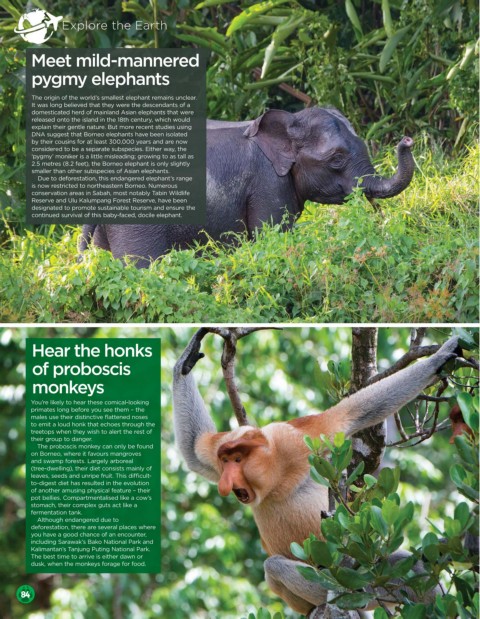
              Meet mild-mannered

              pygmy elephants


              The origin of the world’s smallest elephant remains unclear.
              It was long believed that they were the descendants of a
              domesticated herd of mainland Asian elephants that were
              released onto the island in the 18th century, which would
              explain their gentle nature. But more recent studies using
              DNA suggest that Borneo elephants have been isolated
              by their cousins for at least 300,000 years and are now
              considered to be a separate subspecies. Either way, the
              ‘pygmy’ moniker is a little misleading; growing to as tall as
              2.5 metres (8.2 feet), the Borneo elephant is only slightly
              smaller than other subspecies of Asian elephants.
               Due to deforestation, this endangered elephant’s range
              is now restricted to northeastern Borneo. Numerous
              conservation areas in Sabah, most notably Tabin Wildlife
              Reserve and Ulu Kalumpang Forest Reserve, have been
              designated to promote sustainable tourism and ensure the
              continued survival of this baby-faced, docile elephant.


              Hear the honks

              of proboscis

              monkeys


              You’re likely to hear these comical-looking
              primates long before you see them – the

              males use their distinctive flattened noses
              to emit a loud honk that echoes through the
              treetops when they wish to alert the rest of
              their group to danger.
               The proboscis monkey can only be found
              on Borneo, where it favours mangroves
              and swamp forests. Largely arboreal
              (tree-dwelling), their diet consists mainly of
              leaves, seeds and unripe fruit. This difficult-

              to-digest diet has resulted in the evolution
              of another amusing physical feature – their
              pot bellies. Compartmentalised like a cow’s
              stomach, their complex guts act like a
              fermentation tank.
               Although endangered due to
              deforestation, there are several places where
              you have a good chance of an encounter,
              including Sarawak’s Bako National Park and
              Kalimantan’s Tanjung Puting National Park.
              The best time to arrive is either dawn or
              dusk, when the monkeys forage for food.


           84


       080-087_ExploreTheEarthBorneo.indd   84                                                                               02/03/2016   16:18

