


Page 30 - (DK Eyewitness) Travel Guide - Sicily
P. 30
28 INTRODUCING SICIL Y
Cinema and Theatre in Sicily The TV series Inspector
Montalbano, from the books
Anyone who witnesses the colour of Carnival in Sicily, the by Andrea Camilleri, was also
bustle of the Vucciria market in Palermo or the sombre almost entirely shot in Ragusa.
pageantry of Easter week processions will appreciate that
Sicily is a theatrical place in its own right. The reasons perhaps
lie in the turbulent history of the place. One thing is certain:
the island has been a source of inspiration for both theatre
and cinema, providing subjects from peasant life to the
decadent aristocracy and the Mafia, and producing world-
famous playwrights and award-winning films.
De Seta, following some
fascinating documentaries on
Sicily, directed a feature film
set in Sardinia, Banditi a
Orgosolo (Bandits at Orgo solo,
1961), and Neapolitan director
Francesco Rosi made Salvatore
Giuliano (1961), the story of
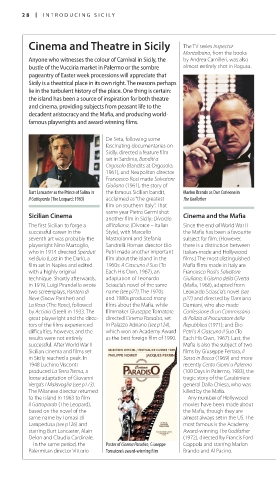
Burt Lancaster as the Prince of Salina in the famous Sicilian bandit, Marlon Brando as Don Corleone in
Il Gattopardo (The Leopard; 1963) acclaimed as “the greatest The Godfather
film on southern Italy”. That
same year Pietro Germi shot
Sicilian Cinema another film in Sicily: Divorzio Cinema and the Mafia
The first Sicilian to forge a all’Italiana, (Divorce – Italian Since the end of World War II
successful career in the Style), with Marcello the Mafia has been a favourite
seventh art was probably the Mastroianni and Stefania subject for film. (However,
playwright Nino Martoglio, Sandrelli. Roman director Elio there is a distinction between
who in 1914 directed Sperduti Petri made another important Italianmade and Hollywood
nel Buio (Lost in the Dark), a film about the island in the films.) The most distinguished
film set in Naples and edited 1960s: A Ciascuno il Suo (To Mafia films made in Italy are
with a highly original Each His Own, 1967), an Fran cesco Rosi’s Salvatore
technique. Shortly afterwards, adaptation of Leonardo Giuliano; Il Giorno della Civetta
in 1919, Luigi Piran dello wrote Sciascia’s novel of the same (Mafia, 1968), adapted from
two screenplays, Pantera di name (see p27). The 1970s Leonardo Sciascia’s novel (see
Neve (Snow Panther) and and 1980s produced many p27) and directed by Damiano
La Rosa (The Rose), followed films about the Mafia, while Damiani, who also made
by Acciaio (Steel) in 1933. The filmmaker Giuseppe Tornatore Confessione di un Commissario
great playwright and the direc directed Cinema Paradiso, set di Polizia al Procuratore della
tors of the films experienced in Palazzo Adriano (see p124), Repubblica (1971); and Elio
difficulties, how ever, and the which won an Academy Award Petri’s A Cias cuno il Suo (To
results were not entirely as the best foreign film of 1990. Each His Own, 1967). Last, the
successful. After World War II Mafia is also the subject of two
Sicilian cinema and films set films by Giuseppe Ferrara, Il
in Sicily reached a peak. In Sasso in Bocca (1969) and more
1948 Luchino Visconti recently Cento Giorni a Palermo
produced La Terra Trema, a (100 Days in Palermo, 1983), the
loose adaptation of Giovanni tragic story of the Carabiniere
Verga’s I Malavoglia (see p173). general Dalla Chiesa, who was
The Milanese director returned killed by the Mafia.
to the island in 1963 to film Any number of Hollywood
Il Gattopardo (The Leopard), movies have been made about
based on the novel of the the Mafia, though they are
same name by Tomasi di almost always set in the US. The
Lampedusa (see p126) and most famous is the Academy
starring Burt Lancaster, Alain Awardwinning The Godfather
Delon and Claudia Cardinale. (1972), direc ted by Francis Ford
In the same period, the Poster of Cinema Paradiso, Giuseppe Coppola and starring Marlon
Palermitan director Vittorio Tornatore’s award-winning film Brando and Al Pacino.
028-029_EW_Sicily.indd 28 11/3/16 2:06 PM

