


Page 245 - (DK Eyewitness) Travel Guide - Europe
P. 245
A MSTERD A M 243
to outlaw the practise, but their
attempts were half-hearted, and
by the mid-17th century, pro-
stitution was openly tolerated.
In 1850, Amsterdam had a
population of 200,000 and a total
of 200 brothels, most of which
catered for rich clients.
Today, the Red Light District,
known locally as de Walletjes
(the little walls), is centered
around the Oude Kerk. The area
is crisscrossed by a network of
tiny lanes lined with garish sex
shops and seedy clubs. At night,
the little alleys assume a sinister
aspect, and it is not wise to
wander around alone, but by
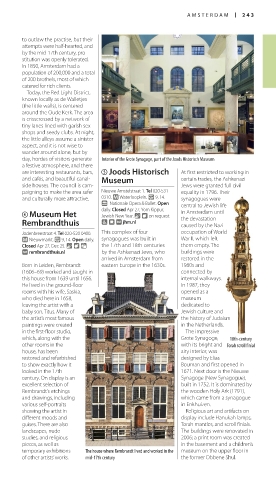
day, hordes of visitors generate Interior of the Grote Synagoge, part of the Joods Historisch Museum
a festive atmosphere, and there
are interesting restaurants, bars, 5 Joods Historisch At first restricted to working in
and cafés, and beautiful canal- Museum certain trades, the Ashkenazi
side houses. The council is cam- Jews were granted full civil
paigning to make the area safer Nieuwe Amstelstraat 1. Tel 020-531 equality in 1796. Their
and culturally more attractive. 0310. q Waterlooplein. v 9, 14. synagogues were
4 Nationale Opera & Ballet. Open central to Jewish life
4 Museum Het daily. Closed Apr 27, Yom Kippur, in Amsterdam until
Jewish New Year. & 8 on request.
Rembrandthuis 7 - ∑ jhm.nl the devastation
caused by the Nazi
Jodenbreestraat 4. Tel 020-520 0400. This complex of four occupation of World
q Nieuwmarkt. v 9, 14. Open daily. synagogues was built in War II, which left
Closed Apr 27, Dec 25. & 8 = the 17th and 18th centuries them empty. The
∑ rembrandthuis.nl by the Ashkenazi Jews, who buildings were
arrived in Amsterdam from restored in the
Born in Leiden, Rembrandt eastern Europe in the 1630s. 1980s and
(1606–69) worked and taught in connected by
this house from 1639 until 1656. internal walkways.
He lived in the ground-floor In 1987, they
rooms with his wife, Saskia, opened as a
who died here in 1658, museum
leaving the artist with a dedicated to
baby son, Titus. Many of Jewish culture and
the artist’s most famous the history of Judaism
paintings were created in the Netherlands.
in the first-floor studio, The impressive
which, along with the Grote Synagoge, 18th-century
other rooms in the with its bright and Torah scroll finial
house, has been airy interior, was
restored and refurbished designed by Elias
to show exactly how it Bouman and first opened in
looked in the 17th 1671. Next door is the Nieuwe
century. On display is an Synagoge (New Synagogue),
excellent selection of built in 1752. It is dominated by
Rembrandt’s etchings the wooden Holy Ark (1791),
and drawings, including which came from a synagogue
various self-portraits in Enkhuizen.
showing the artist in Religious art and artifacts on
different moods and display include Hanukah lamps,
guises. There are also Torah mantles, and scroll finials.
landscapes, nude The buildings were renovated in
studies, and religious 2006; a print room was created
pieces, as well as in the basement and a children’s
temporary exhibitions The house where Rembrandt lived and worked in the museum on the upper floor in
of other artists’ works. mid-17th century the former Obbene Shul.
242-243_EW_Europe.indd 243 14/07/16 10:14 am

