


Page 248 - (DK Eyewitness) Travel Guide - Europe
P. 248
246 FR ANCE AND THE L OW C OUNTRIES
leads to its courtyard merchants, and politicians who
is decorated with began building houses here in
splendid blue and the 1660s. Most of the opulent
white tiles. mansions have been turned
The 85-m (272-ft) into offices or banks, but their
high tower of the elegance gives an insight into the
Westerkerk soars lifestyle of the earliest residents.
above Jordaan’s Two of the finest and best-
streets, and gives preserved buildings are No. 412,
panoramic views of designed by Philips Vingboons in
the city. Begun in 1664, and No. 475, with its two
1620, the church sculpted female figures over the
has the largest front door. Built in 1730, the
nave of any Dutch latter is an example of the
Protestant church. Louis XIV style, which became
Historically a poor popular in the 18th century. The
area, the Jordaan Kattenkabinet (Cat Museum), at
now has a trendy and No. 497, is one of the few houses
bohemian air, with on the Golden Bend accessible
quirky stores selling to the public. It is worth a visit
anything from for its unusual collection of
designer clothes to feline artifacts. Also on view here
old sinks, art galleries, are some splendid paintings by
and lively brown Jacob de Wit (1695–1754) and
cafés and bars spilling an attractive formal garden.
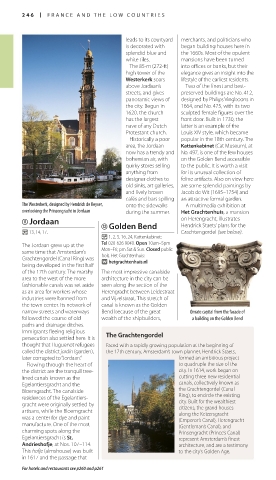
The Westerkerk, designed by Hendrick de Keyser, onto the sidewalks A multimedia exhibition at
overlooking the Prinsengracht in Jordaan during the summer. Het Grachtenhuis, a mansion
q Jordaan w Golden Bend on Herengracht, illustrates
Hendrick Staets’ plans for the
v 13, 14, 17. Grachtengordel (see below).
v 1, 2, 5, 16, 24. Kattenkabinet:
The Jordaan grew up at the Tel 020-626 9040. Open 10am–5pm
same time that Amsterdam’s Mon–Fri; pm Sat & Sun. Closed public
Grachtengordel (Canal Ring) was hols. Het Grachten huis:
∑ hetgrachtenhuis.nl
being developed in the first half
of the 17th century. The marshy The most impressive canalside
area to the west of the more architecture in the city can be
fashionable canals was set aside seen along the section of the
as an area for workers whose Herengracht between Leidestraat
industries were banned from and Vijzelstraat. This stretch of
the town center. Its network of canal is known as the Golden
narrow streets and waterways Bend because of the great Ornate capital from the facade of
followed the course of old wealth of the shipbuilders, a building on the Golden Bend
paths and drainage ditches.
Immigrants fleeing religious
persecution also settled here. It is The Grachtengordel
thought that Huguenot refugees Faced with a rapidly growing population at the beginning of
called the district jardin (garden), the 17th century, Amsterdam’s town planner, Hendrick Staets,
later corrupted to “Jordaan.” formed an ambitious project
Flowing through the heart of to quadruple the size of the
the district are the tranquil tree- city. In 1614, work began on
lined canals known as the cutting three new residential
Egelantiersgracht and the canals, collectively known as
Bloemgracht. The canalside the Grachtengordel (Canal
residences of the Egelantiers- Ring), to encircle the existing
gracht were originally settled by city. Built for the wealthiest
citizens, the grand houses
artisans, while the Bloemgracht along the Keizersgracht
was a center for dye and paint (Emperor’s Canal), Herengracht
manufacture. One of the most (Gentleman’s Canal), and
charming spots along the Prinsengracht (Prince’s Canal)
Egelantiersgracht is St. represent Amsterdam’s finest
Andrieshofje, at Nos. 107–114. archi tecture, and are a testimony
This hofje (almshouse) was built to the city’s Golden Age.
in 1617 and the passage that
For hotels and restaurants see p260 and p261
246-247_EW_Europe.indd 246 14/07/16 10:14 am

