


Page 277 - (DK Eyewitness) Travel Guide - Europe
P. 277
M ADRID 275
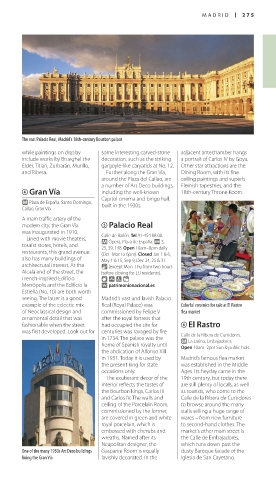
The vast Palacio Real, Madrid’s 18th-century Bourbon palace
while paintings on display some interesting carved-stone adjacent antechamber hangs
include works by Brueghel the decoration, such as the striking a portrait of Carlos IV by Goya.
Elder, Titian, Zurbarán, Murillo, gargoyle-like caryatids at No. 12. Other star attractions are the
and Ribera. Further along the Gran Vía, Dining Room, with its fine
around the Plaza del Callao, are ceiling paintings and superb
a number of Art Deco buildings, Flemish tapestries, and the
4 Gran Vía including the well-known 18th-century Throne Room.
Capitol cinema and bingo hall,
q Plaza de España, Santo Domingo,
Callao, Gran Vía. built in the 1930s.
A main traffic artery of the
modern city, the Gran Vía 5 Palacio Real
was inaugurated in 1910. Calle de Bailén. Tel 91-454 88 00.
Lined with movie theaters, q Ópera, Plaza de España. @ 3,
tourist stores, hotels, and 25, 39, 148. Open 10am–8pm daily
restaurants, this grand avenue (Oct–Mar: to 6pm). Closed Jan 1 & 6,
also has many buildings of May 1 & 15, Sep 9, Dec 24, 25 & 31.
architectural interest. At the & (except Mon–Thu from two hours
Alcalá end of the street, the before closing for EU residents).
French-inspired Edificio 8 d 7 =
Metrópolis and the Edificio la ∑ patrimonionacional.es
Estrella (No. 10) are both worth
seeing. The latter is a good Madrid’s vast and lavish Palacio
example of the eclectic mix Real (Royal Palace) was Colorful ceramics for sale at El Rastro
of Neoclassical design and commissioned by Felipe V flea market
orna mental detail that was after the royal fortress that
fashionable when the street had occupied the site for 6 El Rastro
was first developed. Look out for centuries was ravaged by fire Calle de la Ribera de Curtidores.
in 1734. The palace was the q La Latina, Embajadores.
home of Spanish royalty until Open 10am–2pm Sun & public hols.
the abdication of Alfonso XIII
in 1931. Today it is used by Madrid’s famous flea market
the present king for state was established in the Middle
occasions only. Ages. Its heyday came in the
The exuberant decor of the 19th century, but today there
interior reflects the tastes of are still plenty of locals, as well
the Bourbon kings, Carlos III as tourists, who come to the
and Carlos IV. The walls and Calle de la Ribera de Curtidores
ceiling of the Porcelain Room, to browse around the many
commissioned by the former, stalls selling a huge range of
are covered in green and white wares – from new furniture
royal porcelain, which is to second-hand clothes. The
embossed with cherubs and market’s other main street is
wreaths. Named after its the Calle de Embajadores,
Neapolitan designer, the which runs down past the
One of the many 1930s Art Deco buildings Gasparini Room is equally dusty Baroque facade of the
lining the Gran Vía lavishly decorated. In the Iglesia de San Cayetano.
274-275_EW_Europe.indd 275 14/07/16 10:09 am

