


Page 282 - (DK Eyewitness) Travel Guide - Europe
P. 282
280 THE IBERIAN PENINSULA
Exploring the Prado’s Collection Italian Painting
The importance of the Prado is founded on its royal collections. The most remarkable Italian
The wealth of foreign art, including many of Europe’s finest paintings are Botticelli’s
works, reflects the historical power of the Spanish crown. The dramatic wooden panels that
Low Countries and parts of Italy were under Spanish rule for depict The Story of Nastagio
degli Onesti, Raphael’s Christ
hundreds of years. The 18th century was an era of French Falls on the Way to Calvary
influence, following the Bourbon accession to the Spanish (1516), and Christ Washing the
throne. The Prado is worthy of repeated visits, but if you go Disciples’ Feet (c.1547), by
only once, see the Spanish works of the 17th century. Tintoretto. Venetian masters
Titian – Charles V’s court
painter – and Veronese are
extreme in his painting The equally well represented. Also
Spanish Painting Adoration of the Shepherds on display are works by
Right up to the 19th century, (1612–14). Giordano, Fra Angelico,
Spanish painting focused on The Golden Age of the 17th Caravaggio, and Tiepolo,
religious and royal themes. century produced such great master of Italian Rococo.
There are a few examples of artists as José de Ribera and
Spain’s early-medieval art in the Francisco de Zurbarán. Works
Prado, such as the anonymous by both are on display in the
mural paintings from the Holy Prado. This period, however, is
Cross hermitage in Maderuelo. best represented by the work
Spanish Gothic art can be seen of Diego Velázquez, Spain’s
in the works of Bartolomé leading court painter. Examples
Bermejo and Fernando Gallego. of his royal portraits and
Renaissance features began religious and mythological
to emerge in the paintings of paintings are displayed,
Pedro de Berruguete and including his masterpiece, Las
Fernando Yáñez de la Alme- Meninas (1656), a portrait of the
dina, whose work shows the Infanta Margarita surrounded
influence of Leonardo da Vinci. by her courtiers.
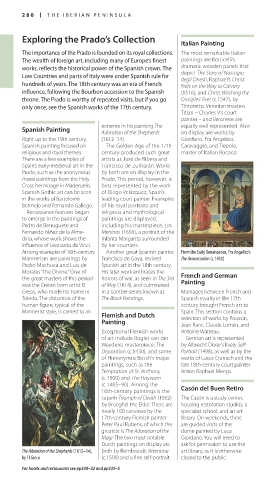
Among examples of 16th-century Another great Spanish painter, From the Early Renaissance, Fra Angelico’s
Mannerism are paintings by Francisco de Goya, revived The Annunciation (c.1430)
Pedro Machuca and Luis de Spanish art in the 18th century.
Morales “the Divine.” One of His later work embraces the French and German
the great masters of this period horrors of war, as seen in The 3rd
was the Cretan-born artist El of May (1814), and culminated Painting
Greco, who made his home in in a somber series known as Marriages between French and
Toledo. The distortion of the The Black Paintings. Spanish royalty in the 17th
human figure, typical of the century brought French art to
Mannerist style, is carried to an Spain. This section contains a
Flemish and Dutch selection of works by Poussin,
Painting
Jean Ranc, Claude Lorrain, and
Exceptional Flemish works Antoine Watteau.
of art include Rogier van der German art is represented
Weyden’s masterpiece, The by Albrecht Dürer’s lively Self-
Deposition (c.1430), and some Portrait (1498), as well as by the
of Hieronymus Bosch’s major works of Lucas Cranach and the
paintings, such as the late 18th-century court painter
Temptation of St. Anthony Anton Raphael Mengs.
(c.1500) and The Haywain
(c.1485–90). Among the
16th-century paintings is the Casón del Buen Retiro
superb Triumph of Death (1562) The Casón is a study center,
by Brueghel the Elder. There are housing restoration studios, a
nearly 100 canvases by the specialist school, and an art
17th-century Flemish painter library. On weekends, there
Peter Paul Rubens, of which the are guided visits of the
greatest is The Adoration of the dome painted by Luca
Magi. The two most notable Giordano. You will need to
Dutch paintings on display are ask for permission to use the
The Adoration of the Shepherds (1612–14), both by Remb randt: Artemisia art library, as it is otherwise
by El Greco (c.1500) and a fine self-portrait. closed to the public.
For hotels and restaurants see pp330–32 and pp333–5
280-281_EW_Europe.indd 280 14/07/16 10:09 am

