


Page 280 - (DK Eyewitness) Travel Guide - Europe
P. 280
278 THE IBERIAN PENINSULA
7 Museo Nacional del Prado
The Prado Museum houses the world’s greatest assembly of Spanish paintings from
the 12th to the 19th century, including major works by Velázquez and Goya. It also
houses impressive foreign collections, particularly of Italian and Flemish works. The
Neoclassical building was designed in 1785 by Juan de Villanueva on the orders of
Carlos III. In 2006, a fully refurbished Casón del Buen Retiro and a new building in
the cloisters on San Jerónimo’s church opened to the public. In 2009, the former
army museum (Salón de Reinos) also became part of the Prado.
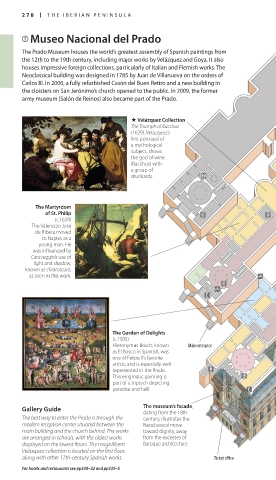
. Velázquez Collection
The Triumph of Bacchus
(1629), Velázquez’s
first portrayal of
a mythological
subject, shows
the god of wine
(Bacchus) with
a group of
drunkards.
The Martyrdom
of St. Philip
(c.1639)
The Valencian José
de Ribera moved
to Naples as a
young man. He
was influenced by
Caravaggio’s use of
light and shadow,
known as chiaroscuro,
as seen in this work.
The Garden of Delights
(c.1505)
Hieronymus Bosch, known Main entrance
as El Bosco in Spanish, was
one of Felipe II’s favorite
artists, and is especially well
represented in the Prado.
This enigmatic painting is
part of a triptych depicting
paradise and hell.
Gallery Guide The museum’s facade,
dating from the 18th
The best way to enter the Prado is through the century, illustrates the
modern reception center situated between the Neoclassical move
main building and the church behind. The works toward dignity, away
are arranged in schools, with the oldest works from the excesses of
displayed on the lowest floors. The magnificent Baroque architecture.
Velázquez collection is located on the first floor,
along with other 17th-century Spanish works. Ticket office
For hotels and restaurants see pp330–32 and pp333–5
278-279_EW_Europe.indd 278 14/07/16 10:09 am

