


Page 278 - (DK Eyewitness) Travel Guide - Europe
P. 278
276 THE IBERIAN PENINSULA
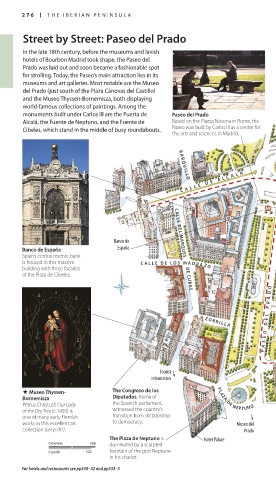
Street by Street: Paseo del Prado
In the late 18th century, before the museums and lavish
hotels of Bourbon Madrid took shape, the Paseo del
Prado was laid out and soon became a fashionable spot
for strolling. Today, the Paseo’s main attraction lies in its
museums and art galleries. Most notable are the Museo
del Prado (just south of the Plaza Cánovas del Castillo)
and the Museo Thyssen-Bornemisza, both displaying
world-famous collections of paintings. Among the
monuments built under Carlos III are the Puerta de Paseo del Prado
Alcalá, the Fuente de Neptuno, and the Fuente de Based on the Piazza Navona in Rome, the
Cibeles, which stand in the middle of busy roundabouts. Paseo was built by Carlos III as a center for
the arts and sciences in Madrid. C I B E
P L A Z A D E
C A L L E D E A L C A L A L E S
B A R Q U I L L O
Banco de CALLE DEL MARQUES
Banco de España España
Spain’s central reserve bank
is housed in this massive
C A L L E D E L O S M A D R A Z O
building with three facades
at the Plaza de Cibeles. DE CUBAS
O
D
A
R
P
L
E
D PLAZA DE LA LEALTAD
Z O R R I L L A
O
E
S
A
P
Tourist
information
. Museo Thyssen- The Congreso de los
Bornemisza Diputados, home of PLAZA DE NEPTUNO
Petrus Christus’s Our Lady the Spanish parliament, CALLE FELIPE IV
of the Dry Tree (c.1450) is witnessed the country’s
one of many early Flemish transition from dictatorship
works in this excellent art to democracy. Museo del
collection (see p281). Prado
The Plaza de Neptuno is Hotel Palace
0 meters 100 dominated by a sculpted
0 yards 100 fountain of the god Neptune
in his chariot.
For hotels and restaurants see pp330–32 and pp333–5
276-277_EW_Europe.indd 276 14/07/16 10:44 am

