


Page 288 - (DK Eyewitness) Travel Guide - Europe
P. 288
286 THE IBERIAN PENINSULA
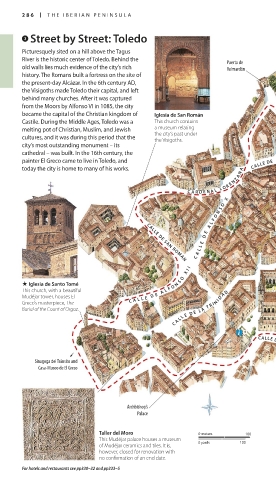
3 Street by Street: Toledo
Picturesquely sited on a hill above the Tagus
River is the historic center of Toledo. Behind the Puerta de
old walls lies much evidence of the city’s rich Valmardón
history. The Romans built a fortress on the site of
the present-day Alcázar. In the 6th century AD,
the Visigoths made Toledo their capital, and left
behind many churches. After it was captured
from the Moors by Alfonso VI in 1085, the city
became the capital of the Christian kingdom of Iglesia de San Román
Castile. During the Middle Ages, Toledo was a This church contains
melting pot of Christian, Muslim, and Jewish a museum relating
the city’s past under
cultures, and it was during this period that the the Visigoths.
city’s most outstanding monument – its
cathedral – was built. In the 16th century, the
painter El Greco came to live in Toledo, and CALLE DE LOS ALFILERITOS
today the city is home to many of his works.
C A R D E N A L L O R E N Z A N A
E A L F O N S O X
C A L L E D
CALLE DE SAN ROMAN
. Iglesia de Santo Tomé C A L L E D E A L F O N S O X I I
This church, with a beautiful
Mudéjar tower, houses El
Greco’s masterpiece, The
Burial of the Count of Orgaz. C A L L E D E L A T R I N I D A D
CALLE DEL CARDENAL CISNEROS
Sinagoga del Tránsito and
Casa-Museo de El Greco
Archbishop’s
Palace
Taller del Moro 0 meters 100
This Mudéjar palace houses a museum 0 yards 100
of Mudéjar ceramics and tiles. It is,
however, closed for renovation with
no confirmation of an end date.
For hotels and restaurants see pp330–32 and pp333–5
286-287_EW_Europe.indd 286 14/07/16 10:15 am

