


Page 310 - (DK Eyewitness) Travel Guide - Europe
P. 310
308 THE IBERIAN PENINSULA
Eastern Spain and the d Valencia
Balearic Islands Valencia. * 810,000. k 8 km (5
miles) SW. £ g @ n Plaza de la
Eastern Spain covers an extraordinary range of climates and Reina 19 (963-15 39 31). _ Las Fallas
landscapes, from the snowbound peaks of the Pyrenees in (Mar 15–19). ∑ turisvalencia.es
Aragón to the beaches of the Costa Blanca. The region has Valencia, Spain’s third-largest
many historical sights, including the striking Mudéjar city, is famous for its ceramics,
churches of Zaragoza and the great cathedral of Valencia. and for the spectacular fiesta
The coastal resorts of Eastern Spain are a popular destination, of Las Fallas, marked by the
erection and burning of
as are the Balearic Islands. Mallorca is the most culturally rich elaborate papier-mâché
of the islands, while Menorca is dotted with prehistoric sites. monuments (fallas).
Ibiza is chiefly known for its exuberant nightlife, but Among the city’s finest
Formentera remains largely unspoiled. Mallorquí, a dialect buildings are La Lonja, an
of the Catalan language brought by 13th-century settlers, exquisite Late Gothic hall built
is still widely spoken on the islands. between 1482 and 1498, and
the cathedral (1262) on Plaza
de la Reina. Other monuments
worth visiting include the
Gothic Palau de la Generalitat,
with its splendidly decorated
first-floor chambers, and the
17th-century Basílica de la
Virgen de los Desamparados.
Beyond the city center is the
Torres de Serranos gateway,
erected in 1391.
Valencia has a number of fine
museums. The Museo de Bellas
Artes holds 2,000 paintings and
statues dating from antiquity to
the 19th century, including six
paintings by Goya, while the
Institut Valencià de Art Modern
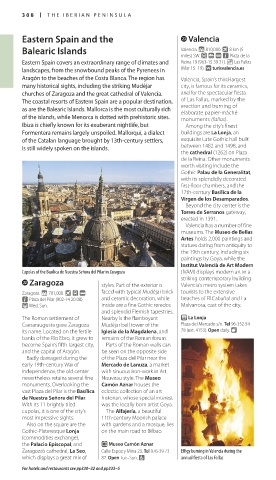
Cupolas of the Basílica de Nuestra Señora del Pilar in Zaragoza (IVAM) displays modern art in a
s Zaragoza styles. Part of the exterior is striking contemporary building.
Valencia’s metro system takes
Zaragoza. * 701,000. k £ @ faced with typical Mudéjar brick tourists to the extensive
n Plaza del Pilar (902-14 20 08). and ceramic decoration, while beaches of El Cabañal and La
( Wed, Sun. inside are a fine Gothic reredos Malvarrosa, east of the city.
and splendid Flemish tapestries.
The Roman settlement of Nearby is the flamboyant P La Lonja
Caesaraugusta gave Zaragoza Mudéjar bell tower of the Plaza del Mercado s/n. Tel 96-352 54
its name. Located on the fertile Iglesia de la Magdalena, and 78 (ext. 4153). Open daily. 8
banks of the Río Ebro, it grew to remains of the Roman forum.
become Spain’s fifth-largest city, Parts of the Roman walls can
and the capital of Aragón. be seen on the opposite side
Badly damaged during the of the Plaza del Pilar near the
early 19th-century War of Mercado de Lanuza, a market
Independence, the old center with sinuous iron-work in Art
nevertheless retains several fine Nouveau style. The Museo
monuments. Overlooking the Camón Aznar houses the
vast Plaza del Pilar is the Basílica eclectic collection of an art
de Nuestra Señora del Pilar. historian, whose special interest
With its 11 brightly tiled was the locally born artist Goya.
cupolas, it is one of the city’s The Alfajería, a beautiful
most impressive sights. 11th-century Moorish palace
Also on the square are the with gardens and a mosque, lies
Gothic-Plateresque Lonja on the main road to Bilbao.
(commodities exchange),
the Palacio Episcopal, and E Museo Camón Aznar
Zaragoza’s cathedral, La Seo, Calle Espoz y Mina 23. Tel 976-39 73 Effigy burning in Valencia during the
which displays a great mix of 87. Open Tue–Sun. 7 annual fiesta of Las Fallas
For hotels and restaurants see pp330–32 and pp333–5
308-309_EW_Europe.indd 308 14/07/16 10:15 am

