


Page 312 - (DK Eyewitness) Travel Guide - Europe
P. 312
310 THE IBERIAN PENINSULA
Southern Spain of these, the Iglesia de Santa
Ana, has an elegant Plateresque
One large region – Andalusia – extends across the south of portal. The Real Chancillería, or
Spain. It was here that the Moors lingered longest and left Royal Chancery (1530), boasts a
their greatest monuments in the cities of Granada, Córdoba, beautiful Renaissance facade.
Málaga, and Seville. The eight southern provinces span a wide Also worth visiting in the
Albaicín district is the Museo
range of landscapes, with deserts in the east, sandy beaches Arqueológico, with Iberian,
along the Costa del Sol, and sherry-producing vineyards Phoenician, and Roman finds.
around Jerez. From flamingoes in the wetland Doñana From one end of the district,
National Park to flamenco – the uniquely Andalusian art a road leads up to Sacro monte.
form – the region has something to interest every visitor. Granada’s gypsies once lived in
the caves lining this hillside.
Their legacy lives on in the
flamenco shows performed
here in the evenings.
From the northern side of the
Alhambra, a footpath leads to
the Generalife (see pp312–13),
the country estate of the Nasrid
kings. The gardens, begun in
the 13th century, originally
contained orchards and pastures.
Today, their lush greenery, pools,
and graceful water fountains
provide a magical setting for
the many events staged each
year between mid-June and
early July on the occasion of
the city’s international music
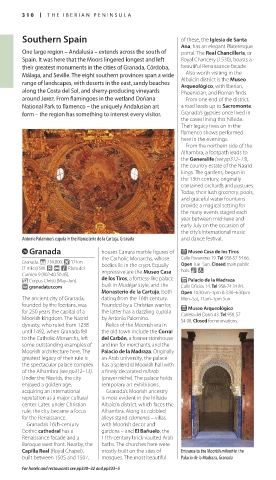
Antonio Palamino’s cupola in the Monasterio de la Cartuja, Granada and dance festival.
h Granada houses Carrara marble figures of E Museo Casa de los Tiros
the Catholic Monarchs, whose Calle Pavaneras 19. Tel 958-57 54 66.
Granada. * 239,000. k 12 km bodies lie in the crypt. Equally Open Tue–Sun. Closed main public
(7 miles) SW. £ @ n Plaza del hols. & 7
Carmen 9 (902-40 50 45). impressive are the Museo Casa
_ Corpus Christi (May–Jun). de los Tiros, a fortress-like palace P Palacio de la Madraza
∑ granadatur.com built in Mudéjar style, and the Calle Oficios 14. Tel 958-24 34 84.
Monasterio de la Cartuja, both Open 10:30am–1pm & 3:30–6:30pm
The ancient city of Granada, dating from the 16th century. Mon–Sat, 11am–1pm Sun.
founded by the Iberians, was Founded by a Christian warrior, E Museo Arqueológico
for 250 years the capital of a the latter has a dazzling cupola Carrera del Darro 43. Tel 958-57
Moorish kingdom. The Nasrid by Antonio Palomino. 54 08. Closed for renovations.
dynasty, who ruled from 1238 Relics of the Moorish era in
until 1492, when Granada fell the old town include the Corral
to the Catholic Monarchs, left del Carbón, a former storehouse
some outstanding examples of and inn for merchants, and the
Moorish architecture here. The Palacio de la Madraza. Originally
greatest legacy of their rule is an Arab university, the palace
the spectacular palace complex has a splendid Moorish hall with
of the Alhambra (see pp312–13). a finely decorated mihrab
Under the Nasrids, the city (prayer niche). The palace holds
enjoyed a golden age, temporary art exhibitions.
acquiring an international Granada’s Moorish ancestry
reputation as a major cultural is most evident in the hillside
center. Later, under Christian Albaicín district, which faces the
rule, the city became a focus Alhambra. Along its cobbled
for the Renaissance. alleys stand cármenes – villas
Granada’s 16th-century with Moorish decor and
Gothic cathedral has a gardens – and El Bañuelo, the
Renaissance facade and a 11th-century brick-vaulted Arab
Baroque west front. Nearby, the baths. The churches here were
Capilla Real (Royal Chapel), mostly built on the sites of Entrance to the Moorish mihrab in the
built between 1505 and 1507, mosques. The most beautiful Palacio de la Madraza, Granada
For hotels and restaurants see pp330–32 and pp333–5
310-311_EW_Europe.indd 310 14/07/16 10:15 am

