


Page 358 - (DK Eyewitness) Travel Guide - Europe
P. 358
356 THE IBERIAN PENINSULA
Southern Portugal
Southern Portugal encompasses the Alentejo and the
Algarve, which are separated by ranges of hills. The Alentejo,
nearly one-third of Portugal, stretches south from the Tagus.
It is typified by vast rolling plains of olive trees, cork oaks, or
wheat, as well as whitewashed villages, castles, and a sense of
space and tranquility. The Algarve is very different from the
rest of Portugal in climate, culture, and scenery.
Its stunning coastline and year-round
mild weather make it a popular Renaissance fountain in Évora’s main
square, Praça do Giraldo
vacation resort.
0 Faro
Roman walls stands the * 55,000. k £ @ n Rua da
University, founded by the Misericórdia 8 (289-803 604). ( daily.
Jesuits in 1559. It was closed in _ Dia da Cidade (Sep 7).
1759 by the Marquês de Pombal
(see p345). The building, with its Faro has been the capital of
graceful cloister and notable the Algarve since 1756. It was
azulejos, forms part of the damaged by the 1755 earth-
present-day university. quake and, although some parts
Évora has more than 20 of the ancient city walls remain,
Carved figures of the Apostles on the portal churches and monasteries, most of the buildings date from
of the Sé, Évora including the 15th-century the 18th or 19th centuries.
São Francisco. The church’s The old city is easy to
9 Évora gruesome 17th-century Capela explore on foot. At its heart
dos Ossos was created from the is the Largo da Sé, lined with
* 55,000. £ @ n Praça do
Giraldo (266-777 071). ( Sat & bones of 5,000 monks. orange trees and flanked by
2nd Tue of month. _ Festa de Northwest of the city stands the 18th-century bishops’
São João (Jun). the remaining 9 km (5 miles) of palace, the Paço Episcopal,
Évora’s aqueduct, the Aqueduto which is still in use today.
Rising dramatically out of the da Água de Prata, (1531–37), The Sé itself is a mixture of
Alentejo plain, the enchanting which was damaged in the Baroque and Renaissance styles
city of Évora is set in Roman, 17th century, during the War. and has a fine 18th-century
medieval, and 17th-century organ. Next to the Sé is the
walls. In 1986, UNESCO declared E Museu de Évora Museu Municipal, which
it a World Heritage site. Largo do Conde de Vila Flor. contains Roman, medieval, and
The fortresslike cathedral, the Tel 266-730 480. Open Tue–Sun. Manueline archaeological
Sé, on the Largo do Marquês de Closed Jan 1, Easter Sun, May 1, Jun finds from all over the region.
Marialva, was begun in 1186. 29, Dec 25. & On the other side of the
The portal is flanked by a pair P University old city wall is the impressive
of unmatched towers. Inside, Largo dos Colegiais. Tel 266-740 875. 18th-century church of
a glittering treasury houses Open Mon–Sat. Closed public hols. São Francisco.
sacred art. Beside it stands a
16th-century palace that houses
the newly renovated Museu de
Évora, which has exhibits on the
history of the city from Roman
columns to modern sculpture.
Opposite the museum is a
Roman temple – erected in
the 2nd or 3rd century AD –
once believed to have been
dedicated to Diana.
Walk from the Sé past the
craft stores of Rua 5 de Outubro
to reach Praça do Giraldo, the
main square, with its Moorish
arcades and central fountain
(1571). In 1573, the square was
the site of an Inquisitional
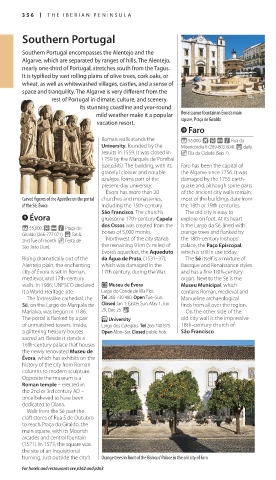
burning. Just outside the city’s Orange trees in front of the Bishops’ Palace in the old city of Faro
For hotels and restaurants see p362 and p363
356-357_EW_Europe.indd 356 14/07/16 10:16 am

