


Page 356 - (DK Eyewitness) Travel Guide - Europe
P. 356
354 THE IBERIAN PENINSULA
300,000 books. Nearby King Dinis (1279–1325), and
is the similarly ornate Inês de Castro, stabbed to death
Capela de São Miguel. here in 1355 (see p351). Nearby
Each May, at the end of is the Portugal dos Pequenitos
the academic year, the theme park.
Queima das Fitas takes
place, at which students P University
hold a ceremonial Largo da Porta Férrea. Tel 239-242
burning of their faculty 744. Open daily. Closed Dec 24 & 25.
ribbons, a tradition that & 7 Library only. ∑ visit.uc.pt
dates back 700 years. E Museu Nacional Machado
Another fascinating de Castro
site is the Museu Largo Dr. José Rodrigues. Tel 239-
Nacional Machado de 853 070. Open Tue pm–Sun. &
Castro, which holds Portugal dos Pequenitos
some of Portugal’s finest Rossio de Santa Clara. Tel 239-801
15th- to 20th-century 170. Open daily. Closed Dec 25.
paintings and sculpture & 7
set among the elegant
16th-century loggias and Environs
courtyards of the former Buçaco National Forest, 16 km
bishops’ palace. (10 miles) north of Coimbra, was
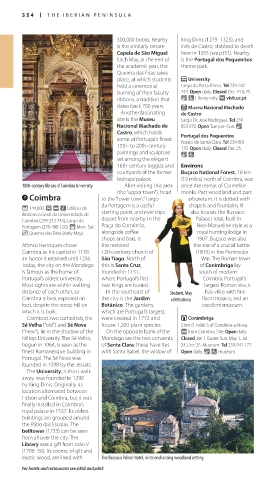
18th-century library of Coimbra University After visiting this area once the retreat of Carmelite
(the “upper town”), head monks. Part woodland and part
7 Coimbra to the “lower town.” Largo arboretum, it is dotted with
da Portagem is a useful chapels and fountains. It
* 144,000. £ @ n Edifício da
Biblioteca Geral da Universidade de starting point, and river trips also houses the Bussaco
Coimbra (239-242 745); Largo da depart from nearby. In the Palace Hotel, built in
Portagem (239-488 120). ( Mon–Sat. Praça do Comércio, Neo-Manueline style as a
_ Queima das Fitas (early May). alongside coffee royal hunting lodge in
shops and bars, is 1907. Buçaco was also
Afonso Henriques chose the restored the site of a crucial battle
Coimbra as his capital in 1139, 12th-century church of (1810) in the Peninsular
an honor it retained until 1256. São Tiago. North of War. The Roman town
Today, the city on the Mondego this is Santa Cruz, of Conímbriga lay
is famous as the home of founded in 1131, south of modern
Portugal’s oldest university. where Portugal’s first Coimbra. Portugal’s
Most sights are within walking two kings are buried. largest Roman site, it
distance of each other, so In the southeast of Student, May has villas with fine
Coimbra is best explored on the city is the Jardim celebrations floor mosaics, and an
foot, despite the steep hill on Botânico. The gardens, excellent museum.
which it is built. which are Portugal’s largest,
Coimbra’s two cathedrals, the were created in 1772 and T Conímbriga
Sé Velha (“old”) and Sé Nova house 1,200 plant species. 2 km (1 mile) S of Condeixa-a-Nova.
(“new”), lie in the shadow of the On the opposite bank of the @ from Coimbra. Site: Open daily.
hilltop University. The Sé Velha, Mondego are the two convents Closed Jan 1, Easter Sun, May 1, Jul
begun in 1064, is seen as the of Santa Clara; these have ties 24, Dec 25. Museum: Tel 239-941 177.
finest Romanesque building in with Santa Isabel, the widow of Open daily. & 7 museum.
Portugal. The Sé Nova was
founded in 1598 by the Jesuits.
The University, a short walk
away, was founded in 1290
by King Dinis. Originally its
location alternated between
Lisbon and Coimbra, but it was
finally installed in Coimbra’s
royal palace in 1537. Its oldest
buildings are grouped around
the Pátio das Escolas. The
belltower (1733) can be seen
from all over the city. The
Library was a gift from João V
(1706–50). Its rooms, of gilt and
exotic wood, are lined with The Bussaco Palace Hotel, in its enchanting woodland setting
For hotels and restaurants see p362 and p363
354-355_EW_Europe.indd 354 14/07/16 10:16 am

