


Page 354 - (DK Eyewitness) Travel Guide - Europe
P. 354
352 THE IBERIAN PENINSULA
Palácio Nacional
de Sintra
At the heart of the old town of Sintra (Sintra Vila),
a pair of unusual conical chimneys rises high
above the Royal Palace. The main part of the
palace, including the central block with its plain
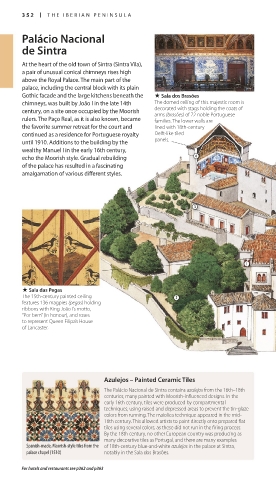
Gothic facade and the large kitchens beneath the . Sala dos Brasões
chimneys, was built by João I in the late 14th The domed ceiling of this majestic room is
century, on a site once occupied by the Moorish decorated with stags holding the coats of
arms (brasões) of 72 noble Portuguese
rulers. The Paço Real, as it is also known, became families. The lower walls are
the favorite summer retreat for the court and lined with 18th-century
continued as a residence for Portuguese royalty Delft-like tiled
until 1910. Additions to the building by the panels.
wealthy Manuel I in the early 16th century,
echo the Moorish style. Gradual rebuilding
of the palace has resulted in a fascinating
amalgamation of various different styles.
. Sala das Pegas
The 15th-century painted ceiling
features 136 magpies (pegas) holding
ribbons with King João I’s motto,
“Por bem” (In honour), and roses
to represent Queen Filipa’s House
of Lancaster.
Azulejos – Painted Ceramic Tiles
The Palácio Nacional de Sintra contains azulejos from the 16th–18th
centuries, many painted with Moorish-influenced designs. In the
early 16th century, tiles were produced by compartmental
techniques, using raised and depressed areas to prevent the tin-glaze
colors from running. The maiolica technique appeared in the mid-
16th century. This allowed artists to paint directly onto prepared flat
tiles using several colors, as these did not run in the firing process.
By the 18th century, no other European country was producing as
many decorative tiles as Portugal, and there are many examples
Spanish-made, Moorish-style tiles from the of 18th-century blue-and-white azulejos in the palace at Sintra,
palace chapel (1510) notably in the Sala dos Brasões.
For hotels and restaurants see p362 and p363
352-353_EW_Europe.indd 352 14/07/16 10:09 am

