


Page 406 - (DK Eyewitness) Travel Guide - Europe
P. 406
404 IT AL Y AND GREECE
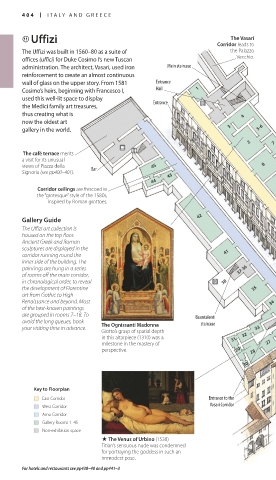
q Uffizi The Vasari
Corridor leads to
The Uffizi was built in 1560–80 as a suite of the Palazzo
offices (uffici) for Duke Cosimo I’s new Tuscan Vecchio.
administration. The architect, Vasari, used iron Main staircase
reinforcement to create an almost continuous
wall of glass on the upper story. From 1581 Entrance
Cosimo’s heirs, beginning with Francesco I, Hall 1
used this well-lit space to display Entrance
the Medici family art treasures,
thus creating what is 4
now the oldest art
gallery in the world. 3 5-6
2 7
The café terrace merits 9
a visit for its unusual
views of Piazza della Bar 45 8
Signoria (see pp400–401).
43 10-14
44
Corridor ceilings are frescoed in
the “grotesque” style of the 1580s,
inspired by Roman grottoes.
42
Gallery Guide
The Uffizi art collection is
housed on the top floor.
Ancient Greek and Roman
sculptures are displayed in the 41
corridor running round the
inner side of the building. The
paintings are hung in a series 37-36
of rooms off the main corridor,
in chronological order, to reveal 38
the development of Florentine 35
art from Gothic to High
Renaissance and beyond. Most 34
of the best-known paintings
are grouped in rooms 7–18. To Buontalenti
avoid the long queues, book staircase
your visiting time in advance. The Ognissanti Madonna 33
Giotto’s grasp of spatial depth 26
in this altarpiece (1310) was a 31 32
milestone in the mastery of 27
perspective. 29 28
30
Key to Floorplan
East Corridor Entrance to the
West Corridor Vasari Corridor
Arno Corridor
Gallery Rooms 1–45
Non-exhibition space
. The Venus of Urbino (1538)
Titian’s sensuous nude was condemned
for portraying the goddess in such an
immodest pose.
For hotels and restaurants see pp438–40 and pp441–3
404-405_EW_Europe.indd 404 09/08/2016 12:11

