


Page 408 - (DK Eyewitness) Travel Guide - Europe
P. 408
406 IT AL Y AND GREECE
Exploring the Uffizi’s Collection
The Uffizi houses some of the greatest art of the Renaissance.
Accumulated over the centuries by the Medici, the collection
was first housed in the Uffizi in 1581, and eventually
bequeathed to the people of Florence by Anna Maria Lodovica,
the last of the Medici (1667–1743). Roman statues collected
by the Medici are on display in the Arno Corridor, but the
pride of the gallery is its matchless collection of paintings.
perspective than Paolo Uccello
(1397–1475), whose Battle of
Gothic Art
San Romano is displayed in
Following the collection of room 7. Portraits include two
statues and antiquities in room panels by Piero della Francesca
1, the gallery’s next six rooms (1410–92), depicting the Duke
are devoted to Tuscan art from and Duchess of Urbino, while
the 12th to the 14th centuries, Fra Filippo Lippi’s Madonna
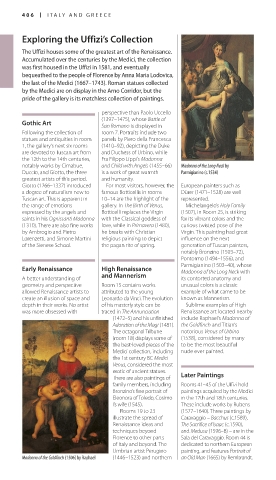
notably works by Cimabue, and Child with Angels (1455–66) Madonna of the Long Neck by
Duccio, and Giotto, the three is a work of great warmth Parmigianino (c.1534)
greatest artists of this period. and humanity.
Giotto (1266–1337) introduced For most visitors, however, the European painters such as
a degree of naturalism new to famous Botticellis in rooms Dürer (1471–1528) are well
Tuscan art. This is apparent in 10–14 are the highlight of the represented.
the range of emotions gallery. In The Birth of Venus, Michelangelo’s Holy Family
expressed by the angels and Botticelli replaces the Virgin (1507), in Room 25, is striking
saints in his Ognissanti Madonna with the Classical goddess of for its vibrant colors and the
(1310). There are also fine works love, while in Primavera (1480), curious twisted pose of the
by Ambrogio and Pietro he breaks with Christian Virgin. This painting had great
Lorenzetti, and Simone Martini religious painting to depict influence on the next
of the Sienese School. the pagan rite of spring. generation of Tuscan painters,
notably Bronzino (1503–72),
Pontormo (1494–1556), and
Parmigianino (1503–40), whose
Early Renaissance High Renaissance Madonna of the Long Neck with
and Mannerism
A better understanding of its contorted anatomy and
geometry and perspective Room 15 contains works unusual colors is a classic
allowed Renaissance artists to attributed to the young example of what came to be
create an illusion of space and Leonardo da Vinci. The evolution known as Mannerism.
depth in their works. No artist of his masterly style can be Sublime examples of High
was more obsessed with traced in The Annunciation Renaissance art located nearby
(1472–5) and his unfinished include Raphael’s Madonna of
Adoration of the Magi (1481). the Goldfinch and Titian’s
The octagonal Tribune notorious Venus of Urbino
(room 18) displays some of (1538), considered by many
the best-loved pieces of the to be the most beautiful
Medici collection, including nude ever painted.
the 1st century BC Medici
Venus, considered the most
erotic of ancient statues.
There are also paintings of Later Paintings
family members, including Rooms 41–45 of the Uffizi hold
Bronzino’s fine portrait of paintings acquired by the Medici
Eleonora of Toledo, Cosimo in the 17th and 18th centuries.
I’s wife (1545). These include works by Rubens
Rooms 19 to 23 (1577–1640). Three paintings by
illustrate the spread of Caravaggio – Bacchus (c.1589),
Renaissance ideas and The Sacrifice of Isaac (c.1590),
techniques beyond and Medusa (1596–8) – are in the
Florence to other parts Sala del Caravaggio. Room 44 is
of Italy and beyond. The dedicated to northern European
Umbrian artist Perugino painting, and features Portrait of
Madonna of the Goldfinch (1506) by Raphael (1446–1523) and northern an Old Man (1665) by Rembrandt.
406-407_EW_Europe.indd 406 14/07/16 10:44 am

