


Page 409 - (DK Eyewitness) Travel Guide - Europe
P. 409
FL ORENCE 407
w Ponte Vecchio opulently decorated with gold
and white stuccoed ceilings. The
@ many routes.
rooms are hung with portraits of
The Ponte Vecchio, the oldest the Medici family and decorated
surviving bridge in the city, with beautiful frescoes and
was designed by Taddeo Gaddi, Gobelins tapestries.
and built in 1345. The three- Other collections at the
arched bridge rests on two Palazzo include the Galleria
stout piers with boat-shaped d’Arte Moderna, with mainly
cutwaters. Its picturesque 19th-century works of art, the
shops were originally occupied Galleria del Costume, opened in
by blacksmiths, butchers, and 1983, which reflects changing
tanners (who used the river taste in courtly fashions, and the
as a convenient garbage Museo degli Argenti which
dump). They were evicted in displays the family’s lavish tastes
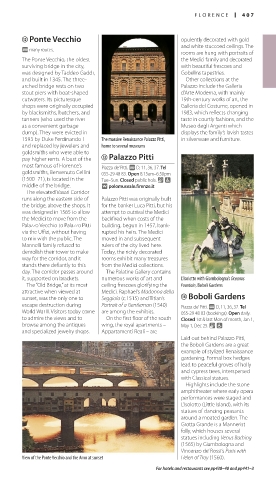
1593 by Duke Ferdinando I The massive Renaissance Palazzo Pitti, in silverware and furniture.
and replaced by jewelers and home to several museums
goldsmiths who were able to
pay higher rents. A bust of the e Palazzo Pitti
most famous of Florence’s Piazza de’ Pitti. @ D, 11, 36, 37. Tel
goldsmiths, Benvenuto Cellini 055-29 48 83. Open 8:15am–6:50pm
(1500–71), is located in the Tue–Sun. Closed public hols. & 7
middle of the bridge. ∑ polomuseale.firenze.it
The elevated Vasari Corridor
runs along the eastern side of Palazzo Pitti was originally built
the bridge, above the shops. It for the banker Luca Pitti, but his
was designed in 1565 to allow attempt to outrival the Medici
the Medici to move from the backfired when costs of the
Palazzo Vecchio to Palazzo Pitti building, begun in 1457, bank-
via the Uffizi, without having rupted his heirs. The Medici
to mix with the public. The moved in and subsequent
Mannelli family refused to rulers of the city lived here.
demolish their tower to make Today, the richly decorated
way for the corridor, and it rooms exhibit many treasures
stands there defiantly to this from the Medici collections.
day. The corridor passes around The Palatine Gallery contains
it, supported on brackets. numerous works of art and L’Isolotto with Giambologna’s Oceanus
The “Old Bridge,” at its most ceiling frescoes glorifying the Fountain, Boboli Gardens
attractive when viewed at Medici. Raphael’s Madonna della
sunset, was the only one to Seggiola (c.1515) and Titian’s r Boboli Gardens
escape destruction during Portrait of a Gentleman (1540) Piazza de’ Pitti. @ D, 11, 36, 37. Tel
World War II. Visitors today come are among the exhibits. 055-29 48 83 (bookings). Open daily.
to admire the views and to On the first floor of the south Closed 1st & last Mon of month, Jan 1,
browse among the antiques wing, the royal apartments – May 1, Dec 25. & 7
and specialized jewelry shops. Appartamenti Reali – are
Laid out behind Palazzo Pitti,
the Boboli Gardens are a great
example of stylized Renaissance
gardening. Formal box hedges
lead to peaceful groves of holly
and cypress trees, interspersed
with Classical statues.
Highlights include the stone
amphitheater where early opera
performances were staged and
L’Isolotto (Little Island), with its
statues of dancing peasants
around a moated garden. The
Grotta Grande is a Mannerist
folly, which houses several
statues including Venus Bathing
(1565) by Giambologna and
Vincenzo de’ Rossi’s Paris with
View of the Ponte Vecchio and the Arno at sunset Helen of Troy (1560).
For hotels and restaurants see pp438–40 and pp441–3
406-407_EW_Europe.indd 407 14/07/16 10:44 am

