


Page 462 - (DK Eyewitness) Travel Guide - Europe
P. 462
460 IT AL Y AND GREECE
Central Greece with the remains of an ancient
sanctuary of Apollo, which had
Beyond the endless urban sprawl of Athens, the vast expanse occupied the site until it was
of central Greece has a little of everything for the visitor, from destroyed in AD 395. In the early
sandy beaches and fishing ports, to one of the country’s most 13th century, Otto de la Roche,
important archaeological sites, Ancient Delphi. Not to be the first Frankish Duke of Athens,
missed is the Byzantine splendor of the monasteries of Dafní bequeathed it to Cistercian
and Osios Loúkas, while the extraordinary mountain-top monks in Burgundy. Greek
Orthodox monks took the site in
monasteries of Metéora are another of the region’s principal the 16th century, erecting the
attractions. The beautiful wooded mountain slopes of the elegant cloisters just south of
Pílio offer some of the best scenery on the mainland. the church. The monastery is
currently being restored, due to
an earthquake which hit in 2000.
Among the monastery’s
principal attractions are the
beautiful gold-leaf Byzantine
mosaics in the katholikón (main
church). Byzantine church
architecture was concerned
almost exclusively with
decoration. Mosaics and
frescoes portraying the whole
body of the Church, from Christ
downward, had a dual purpose:
they gave inspiration to
worshipers and represented
windows to the spiritual world.
The most impressive mosaics
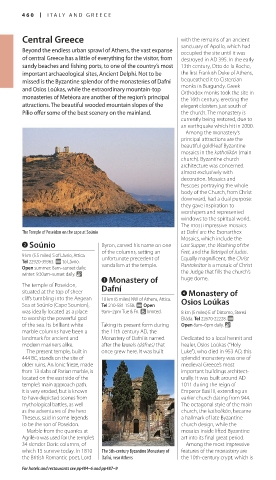
The Temple of Poseidon on the cape at Soúnio at Dafní are the Esonarthex
Mosaics, which include the
2 Soúnio Byron, carved his name on one Last Supper, the Washing of the
of the columns, setting an Feet, and the Betrayal of Judas.
9 km (5.5 miles) S of Lávrio, Attica.
Tel 22920-39363. @ to Lávrio. unfortunate precedent of Equally magnificent, the Christ
Open summer: 8am–sunset daily; vandalism at the temple. Pantokrátor is a mosaic of Christ
winter: 9:30am–sunset daily. & the Judge that fills the church’s
3 Monastery of huge dome.
The temple of Poseidon, Dafní
situated at the top of sheer 4 Monastery of
cliffs tumbling into the Aegean 10 km (6 miles) NW of Athens, Attica. Osios Loúkas
Sea at Soúnio (Cape Sounion), Tel 210-581 1558. @ Open
was ideally located as a place 9am–2pm Tue & Fri. 7 limited. 8 km (5 miles) E of Dístomo, Stereá
to worship the powerful god Elláda. Tel 22670-22228. @
of the sea. Its brilliant white Taking its present form during Open 8am–6pm daily. &
marble columns have been a the 11th century AD, the
landmark for ancient and Monastery of Dafní is named Dedicated to a local hermit and
modern mariners alike. after the laurels (dáfnes) that healer, Osios Loúkas (“Holy
The present temple, built in once grew here. It was built Luke”), who died in 953 AD, this
444 BC, stands on the site of splendid monastery was one of
older ruins. An Ionic frieze, made med ieval Greece’s most
from 13 slabs of Parian marble, is important buildings architect-
located on the east side of the urally. It was built around AD
temple’s main approach path. 1011 during the reign of
It is very eroded, but is known Emperor Basil II, extending an
to have depicted scenes from earlier church dating from 944.
mythological battles, as well The octag onal style of the main
as the adventures of the hero church, the katholikón, became
Theseus, said in some legends a hallmark of late Byzantine
to be the son of Poseidon. church design, while the
Marble from the quarries at mosaics inside lifted Byzantine
Agriléza was used for the temple’s art into its final great period.
34 slender Doric columns, of Among the most impressive
which 15 survive today. In 1810 The 5th-century Byzantine Monastery of features of the monastery are
the British Romantic poet, Lord Dafní, near Athens the 10th-century crypt, which is
For hotels and restaurants see pp484–6 and pp487–9
460-461_EW_Europe.indd 460 14/07/16 10:17 am

