


Page 466 - (DK Eyewitness) Travel Guide - Europe
P. 466
464 IT AL Y AND GREECE
Northern Greece should also make time to see
the museum’s stunning
Northern Greece offers an appealing combination of collection of Macedonian gold.
comparatively unexplored natural beauty and a rich cultural Visitors should not miss the
heritage. The stunning scenery of places like Mount Olympos city’s rich array of UNESCO-listed
holds special appeal to walking enthusiasts, while of historical Byzantine churches, which
include the 5th-century Agios
interest in the region are several ancient archaeological Dimítrios – the largest church
sites, including Pélla, the birthplace of Alexander the Great. in Greece. Dating from the mid-
Many of northern Greece’s finest examples of Byzantine 8th century, Agía Sofía is an
architecture and art are to be found on the Athos Peninsula important building, both for
and in the bustling city of Thessaloníki. its mosaics and for its role in
influencing future architectural
AD 303 by the Emperor development, while the
Galerius to celebrate 14th-century Agios Nikólaos
victory over the Persians, Orfanós contains the best-
and is the principal preserved collection of late
architectural legacy of Byzantine frescoes in the city.
Roman rule. Standing
north of the arch is the E Archaeological Museum
Rotónda, believed to have Manóli Androníkou & Leof Stratoú.
been constructed as a Tel 2310-830538. @ 3. Open
mausoleum for Galerius. summer: 8am–8pm daily; winter:
Open daily, it has been 10am–5pm Mon, 8am–3pm Tue–Sun.
used in the past as both Closed main public hols. & 7
a church and a mosque. ∑ amth.gr
Thessaloníki has a
number of museums, 9 Ancient Pélla
including the Museum of
Byzantine Culture and 38 km (24 miles) NW of Thessaloníki.
the Folk and Ethnological Tel 23820-32963. @ Open daily.
Museum, housed in an Closed main public hols. & 7
ornate, 1906-built mansion.
The 15th-century White Tower on the The star attractions at the This small site was once the
waterfront in Thessaloníki city’s Archaeological flourishing capital of
Museum are the Roman Macedonia. The court was
8 Thessaloníki floor mosaics, and the splendid moved here from Aigai (near
Dervéni Krater, a 4th-century BC modern Vergína) in 410 BC by
* 690,670. k 25 km (15 miles)
SE. g £ @ n 136 Tsimiski bronze wine-mixing bowl. You King Archelaos, who ruled from
(2310-221100).
Thessaloníki, also known as The Macedonian Royal Family
Salonika, is Greece’s second The gold burial casket found at Vergína is emblazoned with the
city, and was founded by King Macedonian Sun, the symbol of the king. Philip II was from a
Kassandros in 315 BC. The capital long line of Macedonian kings that began in about 660 BC with
of the Roman province of Perdiccas I. Philip was the first ruler to unite the whole of Greece as
Macedonia Prima from 146 BC, it existed at that time. Much of Greece’s pride in the symbol lies in
it later became part of the the fact that Alexander the Great used it throughout his empire. He
Byzantine Empire. In 1430 it was was just 20 when his father was assassinated in 336 BC. He inherited
captured by the Turks, who held his father’s already large empire and also his ambition to conquer
it until 1912. Today Thessaloníki the Persians. In 334 BC,
is a bustling cosmopolitan city Alexander crossed the
Dardanelles with 40,000
and a major cultural center. men and defeated the
On the paralía, the city’s Persians in three different
attractive waterfront, stands battles, advancing as
one of Thessaloníki’s most far as the Indus Valley
famous sights, the White before he died at
Tower. Built in 1430, this is the age of 33. With his
one of three towers that death, the Macedonian
were added to the city walls empire divided.
by the Turks. Today it houses
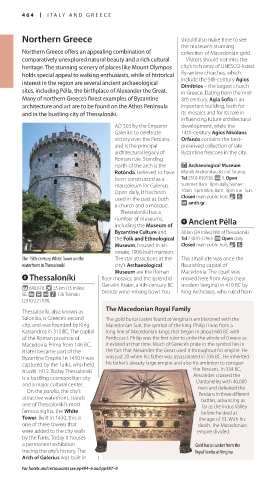
a permanent exhibition Gold burial casket from the
tracing the city’s history. The Royal Tombs at Vergína
Arch of Galerius was built in
For hotels and restaurants see pp484–6 and pp487–9
464-465_EW_Europe.indd 464 14/07/16 10:17 am

