


Page 464 - (DK Eyewitness) Travel Guide - Europe
P. 464
462 IT AL Y AND GREECE
7 Metéora
The extraordinary sandstone towers of Metéora (or “suspended
rocks”) were formed by the action of the sea that covered the
plain of Thessaly around 30 million years ago. The huge columns
of rock were first used as a religious retreat in AD 985, when a
hermit named Barnabas occupied a cave here. In the mid-14th
century, Neílos, the Prior of Stagai convent, built a small church.
A few years later, in 1382, the monk Athanásios, from Mount
Athos, founded the huge monastery of Megálo Metéoro on one
of the many pinnacles. A further 23 monasteries were built,
though most had fallen into ruin by the 19th century. In the
1920s, stairs were cut in the rock faces to make the remaining
six monasteries more accessible, and today a religious revival
has seen an increase in the number of monks and nuns.
MEGALO
METEORO
VARLAAM
AGIOS
NIKOLAOS ROUSANOU
Kalampáka
AGIA TRIADA
AGIOS STEFANOS
Kalampáka
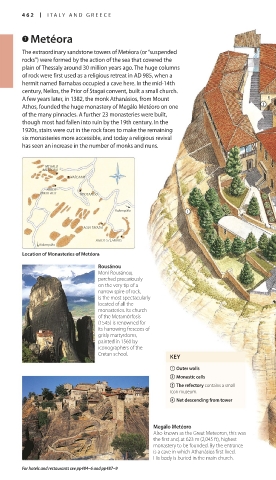
Location of Monasteries of Metéora
Rousánou
Moní Rousánou,
perched precariously
on the very tip of a
narrow spire of rock,
is the most spectacularly
located of all the
monasteries. Its church
of the Metamórfosis
(1545) is renowned for
its harrowing frescoes of
grisly martyrdoms,
painted in 1560 by
iconographers of the
Cretan school.
KEY
1 Outer walls
2 Monastic cells
3 The refectory contains a small
icon museum.
4 Net descending from tower
Megálo Metéoro
Also known as the Great Meteoron, this was
the first and, at 623 m (2,045 ft), highest
monastery to be founded. By the entrance
is a cave in which Athanásios first lived.
His body is buried in the main church.
For hotels and restaurants see pp484–6 and pp487–9
462-463_EW_Europe.indd 462 14/07/16 10:17 am

