


Page 470 - (DK Eyewitness) Travel Guide - Europe
P. 470
468 IT AL Y AND GREECE
u Máni Peninsula Kelefá Castle. Visitors to Inner
Máni should also see the Pýrgos
g Gýtheio. @ Kalamáta (Outer Máni), Diroú cave system, and the
Areópoli (Inner Máni). n Vasiléos
Georgiou 20, Gýtheio (27330-24484). many Byzantine churches
scattered along the west coast.
The harsh and remote Máni Built between the 10th and
Peninsula is divided into two 14th centuries, the finest
areas, Outer Máni and Inner churches include Taxiarchón, at
Máni, separated by a ravine at Charoúda, Agios Theódoros, at
Oítylo. The area is most famous Vámvaka, and, near Ano Mpoul-
for its history of internal feuding, árioi village, Agios Panteleímon,
which led to the building of containing 10th-cen tury
many fine tower houses. From frescoes. Overlooking the sea
the 15th century, rival clansmen, and Cape Taínaro, Vátheia is
fighting over the inadequate one of the most dramatically
land, used the towers to shoot located of the villages in the
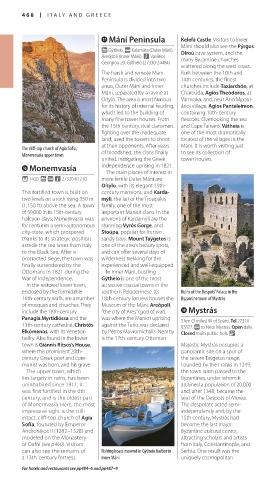
The cliff-top church of Agía Sofía, at their opponents. After years Máni. It is worth visiting just
Monemvasía upper town of bloodshed, the clans finally to see its collection of
united, instigating the Greek tower houses.
y Monemvasía Independence uprising in 1821.
The main places of interest in
* 1420. g @ n 27320-61210. more fertile Outer Máni are
Oítylo, with its elegant 19th-
This fortified town is built on century mansions, and Karda-
two levels on a rock rising 350 m mýli, the lair of the Troupákis
(1,150 ft) above the sea. A town family, one of the most
of 50,000 in its 15th-century important Maniot clans. In the
halcyon days, Monemvasía was environs of Kardamýli are the
for centuries a semi-autonomous stunning Vyrós Gorge, and
city-state, which prospered Stoúpa, popular for its two
thanks to its strategic position sandy bays. Mount Taÿgetos is
astride the sea lanes from Italy one of the area’s beauty spots,
to the Black Sea. After a and can offer several days of
protracted siege, the town was wilderness trekking for the
finally surrendered by the experienced and well-equipped.
Ottomans in 1821 during the In Inner Máni, bustling
War of Independence. Gýtheio is one of the most
In the restored lower town, attractive coastal towns in the
enclosed by the formidable southern Peloponnese. Its Ruins of the Despots’ Palace in the
16th-century walls, are a number 18th-century fortress houses the Byzantine town of Mystrás
of mosques and churches. They Museum of the Máni. Areópoli,
include the 18th-century “the city of Ares” (god of war), i Mystrás
Panagía Myrtidióssa and the was where the Maniot uprising 5 km (3 miles) W of Spárti. Tel 27310-
13th-century cathedral, Christós against the Turks was declared 83377. @ to Néos Mystrás. Open daily.
Elkómenos, with its Venetian by Pétros Mavromichális. Nearby Closed main public hols. &
belfry. Also found in the lower is the 17th-century Ottoman
town is Giánnis Rítsos’s House, Majestic Mystrás occupies a
where this prominent 20th- panoramic site on a spur of
century Greek poet and com- the severe Taÿgetos range.
munist was born, and his grave. Founded by the Franks in 1249,
The upper town, which the town soon passed to the
lies largely in ruins, has been Byzantines, under whom it
uninhabited since 1911. It attained a population of 20,000
was first fortified in the 6th and, after 1348, became the
century, and is the oldest part seat of the Despots of Morea.
of Monemvasía. Here, the most The despotate acted semi-
impressive sight is the still- independently and, by the
intact, cliff-top church of Agía 15th century, Mystrás had
Sofía, founded by Emperor become the last major
Andronikos II (1282–1328) and Byzantine cultural center,
modeled on the Monastery attracting scholars and artists
of Dafní (see p460). Visitors from Italy, Constantinople, and
can also see the remains of Fishing boats moored in Gýtheio harbor in Serbia. One result was the
a 13th-century fortress. Inner Máni uniquely cosmopolitan
For hotels and restaurants see pp484–6 and pp487–9
468-469_EW_Europe.indd 468 14/07/16 10:17 am

