


Page 469 - (DK Eyewitness) Travel Guide - Europe
P. 469
GREECE 467
of interest at the site are the t Náfplio
remains of the Royal Palace, * 14,200. £ @ n Inside Town
the Secret Stairway, which Hall, Vasiléos Konstantínou (27520-
leads down to a cistern deep 24444).
beneath the citadel, and the
13th-century BC Lion Gate, the One of the most elegant towns
grand entrance to Mycenae. in mainland Greece, Náfplio
emerged in the 13th century
r Epidaurus and later endured many sieges
during the struggles between
30 km (19 miles) E of Náfplio. the Turks and the Venetians for
Tel 27530-22009. @ Open 8am–8pm the ports of the Peloponnese.
daily (to 5pm Nov–Mar). Closed main From 1829 to 1834, it was the
public hols. & 7 limited. 8 first capital of liberated Greece.
A number of fortifications
Active from the 6th century BC testify to the town’s checkered
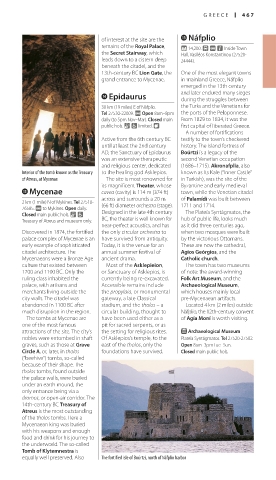
until at least the 2nd century history. The island fortress of
AD, the Sanctuary of Epidaurus Boúrtzi is a legacy of the
was an extensive therapeutic second Venetian occupation
and religious center, dedicated (1686–1715). Akronafplía, also
Interior of the tomb known as the Treasury to the healing god Asklepios. known as Its Kale (“Inner Castle”
of Atreus, at Mycenae The site is most renowned for in Turkish), was the site of the
its magnificent Theater, whose Byzantine and early medieval
e Mycenae cavea (cavity) is 114 m (374 ft) town, while the Venetian citadel
across and surrounds a 20 m of Palamídi was built between
2 km (1 mile) N of Mykínes. Tel 27510-
76585. @ to Mykínes. Open daily. (66 ft) diameter orchestra (stage). 1711 and 1714.
Closed main public hols. & 7 Designed in the late 4th century The Plateía Syntágmatos, the
Treasury of Atreus and museum only. BC, the theater is well known for hub of public life, looks much
near-perfect acoustics, and has as it did three centuries ago,
Discovered in 1874, the fortified the only circular orchestra to when two mosques were built
palace complex of Mycenae is an have survived from antiquity. by the victorious Ottomans.
early example of sophisticated Today, it is the venue for an These are now the cathedral,
citadel architecture. The annual summer festival of Agios Geórgios, and the
Mycenaeans were a Bronze Age ancient drama. Catholic church.
culture that existed between Most of the Asklepieion, The town has two museums
1700 and 1100 BC. Only the or Sanctuary of Asklepios, is of note: the award-winning
ruling class inhabited the currently being re-excavated. Folk Art Museum, and the
palace, with artisans and Accessible remains include Archaeological Museum,
merchants living outside the the propylaia, or monumental which houses mainly local
city walls. The citadel was gateway, a late Classical pre-Mycenaean artifacts.
abandoned in 1100 BC after stadium, and the tholos – a Located 4 km (2 miles) outside
much disruption in the region. circular building, thought to Náfplio, the 12th-century convent
The tombs at Mycenae are have been used either as a of Agía Moní is worth visiting.
one of the most famous pit for sacred serpents, or as
attractions of the site. The city’s the setting for religious rites. E Archaeological Museum
nobles were entombed in shaft Of Asklepios’s temple, to the Plateía Syntágmatos. Tel 27520-27502.
graves, such as those at Grave east of the tholos, only the Open 8am–3pm Tue–Sun.
Circle A, or, later, in tholos foundations have survived. Closed main public hols.
(“beehive”) tombs, so-called
because of their shape. The
tholos tombs, found outside
the palace walls, were buried
under an earth mound, the
only entrance being via a
dromos, or open-air corridor. The
14th-century BC Treasury of
Atreus is the most outstanding
of the tholos tombs. Here a
Mycenaean king was buried
with his weapons and enough
food and drink for his journey to
the underworld. The so-called
Tomb of Klytemnestra is
equally well preserved. Also The fortified isle of Boúrtzi, north of Náfplio harbor
466-467_EW_Europe.indd 467 14/07/16 10:17 am

