


Page 471 - (DK Eyewitness) Travel Guide - Europe
P. 471
GREECE 469
decoration of Mystrás’s churches,
whose pastel-colored frescoes,
crowded with detail, reflect
Italian Renaissance influence.
Now in ruins, Mystrás consists
of an upper and lower town,
with a wealth of churches,
monasteries, palaces, and houses
lining its narrow streets. Among
the churches and monasteries
worth visiting are Mitrópoli – the
oldest church in Mystrás, dating
from 1291– Moní Perivléptou,
from 1310, and Moní
Pantánassas, from 1428. The
Vrontóchion, a 13th-century
monastic complex, was the
cultural heart of medieval
Mystrás. Visitors can also explore
the ruins of the Despots’ Palace,
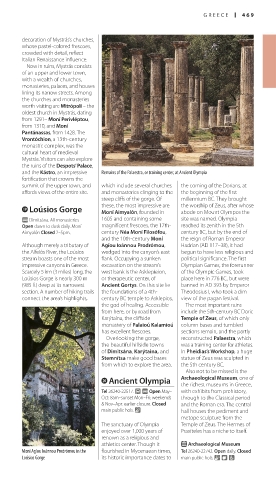
and the Kástro, an impressive Remains of the Palaestra, or training center, at Ancient Olympia
fortification that crowns the
summit of the upper town, and which include several churches the coming of the Dorians, at
affords views of the entire site. and monasteries clinging to the the beginning of the first
steep cliffs of the gorge. Of millennium BC. They brought
o Loúsios Gorge these, the most impressive are the worship of Zeus, after whose
abode on Mount Olympos the
Moní Aimyalón, founded in
@ Dimitsána. All monasteries 1605 and containing some site was named. Olympia
Open dawn to dusk daily. Moní magnificent frescoes, the 17th- reached its zenith in the 5th
Aimyalón Closed 2–5pm. century Néa Moní Filosófou, century BC, but by the end of
and the 10th-century Moní the reign of Roman Emperor
Although merely a tributary of Agíou Ioánnou Prodrómou, Hadrian (AD 117–38), it had
the Alfeiós River, the Loúsios wedged into the canyon’s east begun to have less religious and
stream boasts one of the most flank. Occupying a sunken political significance. The first
impressive canyons in Greece. excavation on the stream’s Olympian Games, the forerunner
Scarcely 5 km (3 miles) long, the west bank is the Asklepieion, of the Olympic Games, took
Loúsios Gorge is nearly 300 m or therapeutic center, of place here in 776 BC, but were
(985 ft) deep at its narrowest Ancient Gortys. On this site lie banned in AD 393 by Emperor
section. A number of hiking trails the foundations of a 4th- Theodosius I, who took a dim
connect the area’s high lights, century BC temple to Asklepios, view of the pagan festival.
the god of healing. Accessible The most important ruins
from here, or by road from include the 5th-century BC Doric
Karýtaina, the cliffside Temple of Zeus, of which only
monastery of Palaioú Kalamioú column bases and tumbled
has excellent frescoes. sections remain, and the partly
Overlooking the gorge, reconstructed Palaestra, which
the beautiful hillside towns was a training center for athletes.
of Dimitsána, Karýtaina, and In Pheidias’s Workshop, a huge
Stemnítsa make good bases statue of Zeus was sculpted in
from which to explore the area. the 5th century BC.
Also not to be missed is the
p Ancient Olympia Archaeological Museum, one of
the richest museums in Greece,
Tel 26240-22517. £ @ Open May– with exhibits from prehistory,
Oct: 8am–sunset Mon–Fri; weekends through to the Classical period
& Nov–Apr: earlier closure. Closed and the Roman era. The central
main public hols. & hall houses the pediment and
metope sculpture from the
The sanctuary of Olympia Temple of Zeus. The Hermes of
enjoyed over 1,000 years of Praxiteles has a niche to itself.
renown as a religious and
athletics center. Though it E Archaeological Museum
Moní Agíou Ioánnou Prodrómou in the flourished in Mycenaean times, Tel 26240-22742. Open daily. Closed
Loúsios Gorge its historic importance dates to main public hols. & 8 7
468-469_EW_Europe.indd 469 14/07/16 10:17 am

