


Page 699 - (DK Eyewitness) Travel Guide - Europe
P. 699
BUD APEST 697
finest example of Gothic stone The complex houses an
carving in Hungary. Also fascin institute of water therapy.
ating is a Baroque statue of the The baths are separated
Madonna; according to legend, into different areas for men
the original was set into a wall and women. Each has
during the Turkish occu pation. plunge pools, a sauna,
When the church was virtually and a steam bath.
destroyed in 1686, the The facilities have been
Madonna made a mira modernized, but the
culous reappear ance, glorious Secession
which the Turks took as interiors remain.
an omen of defeat. There is also an
Mátyás church stands outdoor swimming
in the heart of Buda’s pool with a wave
old town, which machine, installed in
developed to the north of 1927 and still in operation.
West front of the Mátyás Church, with the the Royal Palace from The baths and health
tiled Béla Tower on the left the 1200s onward. spa, with their sun
2 Mátyás Church In front of the Baroque Madonna, terraces, restaurants,
church is Holy Trinity
and cafés, are open
Szentháromság tér 2. Tel (1) 489 07 16. Square, with a Mátyás Church to the public as well
@ 16, 16A, 116. Open daily. Closed memorial column to as to hotel guests.
Sat pm, Sun am. & 8 7 those who died in the plague of
∑ matyas-templom.hu 1691. On the square stands the
Old Town Hall, an elegant Other Museums
This church is mainly a Neo Baroque building with an in Budapest
Gothic reconstruction dating oniondomed clock tower.
from 1874–96. Most of the Practical Information
original church (13th–15th 3 Gellért Hotel and Franz Liszt Museum:
centuries) was lost when the Bath Complex Vörösmarty utca 35. Tel (1) 413 04
Turks turned it into their Great 40. Open Mon–Sat. &
∑ lisztmuseum.hu
Mosque in 1541. The building Szent Gellért tér 1. Tel (1) 466 61 66. Museum in a house built in 1877
had to be restored again after q Szent Gellért tér. @ 7, 86. v 18, for Liszt (1811–86).
damage in World War II. The 19, 47, 49. Open daily. & 7 Kodály Memorial Museum:
great rose window has been ∑ gellertbath.hu Andrássy út 87–89. Tel (1) 352
faithfully reproduced in its 7106. Open Wed–Sun. &
original Gothic style. The earliest reference to the ∑ kodaly-inst.hu
The tombs of King Béla III presence of healing waters at The house in which the
(13th century) and his wife can this site is found in the 13th composer Kodály (1882–1967)
be seen in the Trinity Chapel, century. In the later Middle Ages, lived and worked.
while the Mary Portal (near the a hos pital stood here and then, Museum of Applied Arts:
main altar) is considered the during the Turkish occupation, Üllői út 33–37. Tel (1) 456 51 07.
baths were built. The area Open Tue–Sun. & 7
takes its name from Bishop ∑ imm.hu
Gellért, whose monument Fine collection of decorative arts,
on the hill is visible from especially Art Nouveau artifacts.
many parts of the city. He Ludwig Museum – Museum of
was supposedly martyred Contemporary Art:
Komor Marcell utca 1.
here in 1046 by a group Tel (1) 555 34 44.
opposed to the intro Open Tue–Sun. & 7
duction of Christianity. From ∑ ludwigmuseum.hu
the top of the hill, one can A contemporary art museum with
admire a beautiful view of works by Warhol and Hockney.
the whole of Budapest.
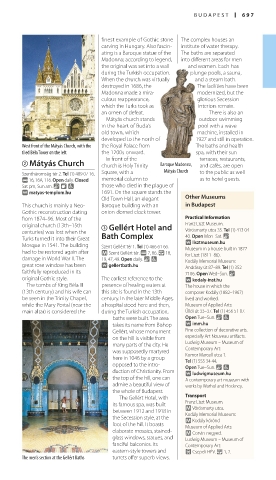
The Gellért Hotel, with Transport
its famous spa, was built Franz Liszt Museum:
q Vörösmarty utca.
between 1912 and 1918 in Kodály Memorial Museum:
the Secession style, at the q Kodály körönd
foot of the hill. It boasts Museum of Applied Arts:
elaborate mosaics, stained q Corvinnegyed.
glass windows, statues, and Ludwig Museum – Museum of
fanciful balconies. Its Contemporary Art:
easternstyle towers and £ Csepeli HÉV. v 1, 2.
The men’s section at the Gellért Baths turrets offer superb views.
696-697_EW_Europe.indd 697 14/07/16 10:20 am

