


Page 700 - (DK Eyewitness) Travel Guide - Europe
P. 700
698 CENTR AL AND EASTERN EUROPE
Pest
At the end of the 17th century, much of the walled city
of Pest, on the east bank of the Danube, was in ruins and
few residents remained. Gradually, new residential districts
began to be developed, extending beyond the medieval
walls, and people started to return.
After a flood in 1838, which destroyed most of the rural
dwellings in the areas around Pest, redevelopment schemes
introduced grand houses and apartment blocks. The area
of Városliget (City Park), once an expanse of marshland,
was also developed in the 19th century.
The first bridge linking Pest and Buda was built in 1766.
The two cities were united as Budapest in 1873.
5 Hungarian
National Museum
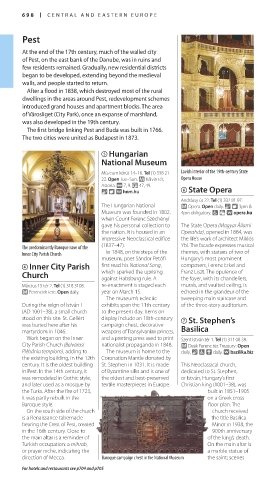
Múzeum körút 14–16. Tel (1) 338 21 Lavish interior of the 19th-century State
22. Open Tue–Sun. q Kálvin tér, Opera House
Astoria. @ 7, 9. v 47, 49.
& 8 ∑ hnm.hu 6 State Opera
Andrássy út 22. Tel (1) 332 81 97.
The Hungarian National q Opera. Open daily. & 8 3pm &
Museum was founded in 1802, 4pm obligatory. 7 = ∑ opera.hu
when Count Ferenc Széchényi
gave his personal collection to The State Opera (Magyar Állami
the nation. It is housed in an Operaház), opened in 1884, was
impressive Neoclassical edifice the life’s work of architect Miklós
The predominantly Baroque nave of the (1837–47). Ybl. The facade expresses musical
Inner City Parish Church In 1848, on the steps of the themes, with statues of two of
museum, poet Sándor Petőfi Hungary’s most prominent
4 Inner City Parish first read his National Song, composers, Ferenc Erkel and
Church which sparked the uprising Franz Liszt. The opulence of
against Habsburg rule. A
the foyer, with its chandeliers,
Március 15 tér 2. Tel (1) 318 3108. re-enactment is staged each murals, and vaulted ceiling, is
q Ferenciek tere. Open daily. year on March 15. echoed in the grandeur of the
The museum’s eclectic sweeping main staircase and
During the reign of István I exhibits span the 11th century of the three-story auditorium.
(AD 1001–38), a small church to the present day. Items on
stood on this site. St. Gellért display include an 18th-century 7 St. Stephen’s
was buried here after his campaign chest, decorative
martyrdom in 1046. weapons of Transylvanian princes, Basilica
Work began on the Inner and a printing press used to print Szent István tér 1. Tel (1) 311 08 39.
City Parish Church (Belvárosi nationalist propaganda in 1848. q Deák Ferenc tér. Treasury: Open
Plébánia templom), adding to The museum is home to the daily. & 7 5 daily. ∑ bazilika.biz
the existing building, in the 12th Coronation Mantle donated by
century. It is the oldest building St. Stephen in 1031. It is made This Neoclassical church,
in Pest. In the 14th century, it of Byzantine silks and is one of dedicated to St. Stephen,
was remodeled in Gothic style, the oldest and best-preserved or István, Hungary’s first
and later used as a mosque by textile masterpieces in Europe. Christian king (1001–38), was
the Turks. After the fire of 1723, built in 1851–1905
it was partly rebuilt in the on a Greek cross
Baroque style. floor plan. The
On the south side of the church church received
is a Renaissance tabernacle the title Basilica
bearing the Crest of Pest, created Minor in 1938, the
in the 16th century. Close to 900th anniversary
the main altar is a reminder of of the king’s death.
Turkish occupation: a mihrab, On the main altar is
or prayer niche, indicating the a marble statue of
direction of Mecca. Baroque campaign chest in the National Museum the saint; scenes
For hotels and restaurants see p704 and p705
698-699_EW_Europe.indd 698 14/07/16 10:25 am

