


Page 703 - (DK Eyewitness) Travel Guide - Europe
P. 703
HUNGAR Y 701
5 Pécs affords stunning views of the
* 146,000. £ @ n Széchenyi town and surrounding vineyards.
tér 7 Tel (72) 511 232. Eger’s 40-m- (130-ft-) minaret
is a relic of 16th-century
First a Celtic, then a Roman Turkish occupation, while the
settlement, Pécs was later splendid Baroque Minorite
ruled by the Turks from 1543 Church on Dobó István tér
until 1686. Several monuments dates from the 1770s.
testify to these different periods Eger Castle was built in the
of Pécs’ history. 13th century following the
The city’s main square, Mongol invasion. The castle
Széchenyi tér, is overlooked by complex includes the Bishop’s
the Catholic Church, formerly Palace (1470), which houses a
the Mosque of Gazi Kasim museum of historical artifacts,
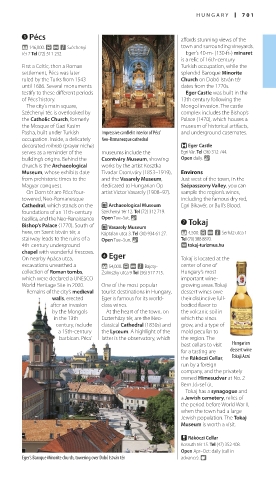
Pasha, built under Turkish Impressive candlelit interior of Pécs’ and underground casemates.
occupation. Inside, a delicately Neo-Romanesque cathedral
decorated mihrab (prayer niche) + Eger Castle
serves as a reminder of the museums include the Egri Vár. Tel (36) 312 744.
building’s origins. Behind the Csontváry Museum, showing Open daily. &
church is the Archaeological works by the artist Kosztka
Museum, whose exhibits date Tivadar Csontváry (1853–1919), Environs
from prehistoric times to the and the Vasarely Museum, Just west of the town, in the
Magyar conquest. dedicated to Hungarian Op Szépasszony Valley, you can
On Dom tér are Pécs’ four- artist Victor Vasarely (1908–97). sample the region’s wines,
towered, Neo-Romanesque including the famous dry red,
Cathedral, which stands on the E Archaeological Museum Egri Bikavér, or Bull’s Blood.
foundations of an 11th-century Széchenyi tér 12. Tel (72) 312 719.
basilica, and the Neo-Renaissance Open Tue–Sat. & 7 Tokaj
Bishop’s Palace (1770). South of E Vasarely Museum
here, on Szent István tér, a Káptalan utca 3. Tel (30) 934 61 27. * 4,500. £ @ n Serház utca 1
stairway leads to the ruins of a Open Tue–Sun. & Tel (70) 388 8870.
4th-century underground ∑ tokaj-turizmus.hu
chapel with wonderful frescoes. 6 Eger
On nearby Apáca utca, Tokaj is located at the
excavations unearthed a * 54,000. £ @ n Bajcsy- center of one of
collection of Roman tombs, Zsilinszky utca 9 Tel (36) 517 715. Hungary’s most
which were declared a UNESCO important wine-
World Heritage Site in 2000. One of the most popular growing areas. Tokaji
Remains of the city’s medieval tourist destinations in Hungary, dessert wines owe
walls, erected Eger is famous for its world- their distinctive full-
after an invasion class wines. bodied flavor to
by the Mongols At the heart of the town, on the volcanic soil in
in the 13th Eszterházy tér, are the Neo- which the vines
century, include classical Cathedral (1830s) and grow, and a type of
a 15th-century the Lyceum. A highlight of the mold peculiar to
barbican. Pécs’ latter is the observatory, which the region. The
best cellars to visit Hungarian
for a tasting are dessert wine
the Rákóczi Cellar, Tokaji Aszú
run by a foreign
company, and the privately
owned Hímesudvar at No. 2
Bem József út.
Tokaj has a synagogue and
a Jewish cemetery, relics of
the period before World War II,
when the town had a large
Jewish population. The Tokaj
Museum is worth a visit.
Rákóczi Cellar
Kossuth tér 15. Tel (47) 352 408.
Open Apr–Oct: daily (call in
Eger’s Baroque Minorite church, towering over Dobó István tér advance). 8
700-701_EW_Europe.indd 701 14/07/16 10:20 am

