


Page 721 - (DK Eyewitness) Travel Guide - Europe
P. 721
KR AK OW 719
Assumption of the Virgin. There is Y Planty
also a fine crucifix by Veit Stoss, Open daily.
known as the Slacker Crucifix. The Planty green belt follows the
outline of Krakow’s medieval
E Czartoryski Museum walls, which were demolished in
Św. Jana 19. Tel 012-422 55 66. the early 19th century. A circuit
@ 152, 304, 502. v 2, 3, 4, 14, 19, 24. through the park of about 5 km
Open Tue–Sun. & 8 (Sun). (3 miles) starting from Wawel
The core of the museum is the leads along tree-lined paths and
art collection assembled by avenues, past fountains and
Princess Isabella Czartoryska statues. Only a small stretch of
in the late 18th century. It the city walls survives beside St.
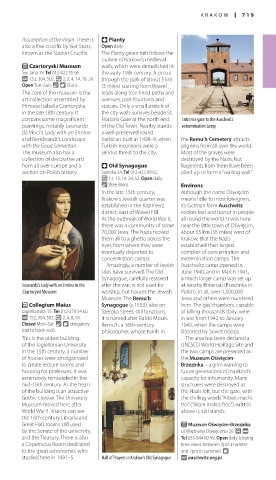
contains some magnificent Florian’s Gate at the north end Entrance gate to the Auschwitz
paintings, notably Leonardo of the Old Town. Nearby stands extermination camp
da Vinci’s Lady with an Ermine a well-preserved round
and Rembrandt’s Landscape barbican built in 1498–9, when the Remu’h Cemetery attracts
with the Good Samaritan. Turkish incursions were a pilgrims from all over the world.
The museum also has a serious threat to the city. Most of the graves were
collection of decorative arts destroyed by the Nazis, but
from all over Europe and a u Old Synagogue fragments from them have been
section on Polish history. Szeroka 24. Tel 012-422 09 62. piled up to form a “wailing wall.”
v 11, 13, 19, 24, 52. Open daily.
& (free Mon). Environs
In the late 15th century, Although the name Oświęcim
Krakow’s Jewish quarter was means little to most foreigners,
established in the Kazimierz its German form Auschwitz
district, east of Wawel Hill. evokes fear and horror in people
At the outbreak of World War II, all round the world. It was here
there was a community of some near the little town of Oświęcim,
70,000 Jews. The Nazis moved about 55 km (35 miles) west of
them all to a ghetto across the Krakow, that the Nazis
river, from where they were established their largest
eventually deported to complex of concentration and
concentration camps. extermination camps. The
Amazingly, a number of Jewish Auschwitz camp opened in
sites have survived. The Old June 1940, and in March 1941,
Synagogue, carefully restored a much larger camp was set up
Leonardo’s Lady with an Ermine in the after the war, is not used for at nearby Birkenau (Brzezinka in
Czartoryski Museum worship, but houses the Jewish Polish). In all, over 1,500,000
Museum. The Remu’h Jews and others were murdered
P Collegium Maius Synagogue (c.1553), also on here. The gas chambers, capable
Jagiellońska 15. Tel 012-370 54 60. Szeroka Street, still functions. of killing thousands daily, were
@ 152, 304, 502. v 2, 4, 8, 18. It is named after Rabbi Moses in use from 1942 to January
Closed Mon–Sat. & 8 obligatory Remu’h, a 16th-century 1945, when the camps were
(call to book visit). philosopher, whose tomb in liberated by Soviet troops.
This is the oldest building The area has been declared a
of the Jagiellonian University. UNESCO World Heritage Site and
In the 15th century, a number the two camps are preserved as
of houses were amalgamated the Muzeum Oświęcim-
to create lecture rooms and Brzezinka – a grim warning to
housing for professors. It was future generations of mankind’s
extensively remodeled in the capacity for inhumanity. Many
mid-19th century. At the heart structures were destroyed as
of the building is an attractive the Nazis left, but the gate, with
Gothic cloister. The University the chilling words “Arbeit macht
Museum moved here after frei” (“Work makes free”) written
World War II. Visitors can see above it, still stands.
the 16th-century Libraria and
Great Hall, rooms still used E Muzeum Oświęcim-Brzezinka
by the Senate of the university, ul. Więźniów Oświęcimia 20. £ @
and the Treasury. There is also Tel 033-844 80 99. Open daily (closing
a Copernicus Room dedicated time varies between 3pm in winter
to the great astronomer, who and 7pm in summer). 8
studied here in 1491–5. Hall of Prayers in Krakow’s Old Synagogue ∑ auschwitz.org.pl
718-719_EW_Europe.indd 719 14/07/16 10:11 am

