


Page 720 - (DK Eyewitness) Travel Guide - Europe
P. 720
718 CENTR AL AND EASTERN EUROPE
Krakow: the Old Quarter
In 1257, Krakow was granted a charter by Duke Bolesław
the Chaste. This was of key importance to the city, ensuring
local government and trade privileges and stimulating the
city’s future development. The charter stipulated certain
conditions: a large centrally located square, surrounded by a
regular grid of streets, was to become the city center. The size
of each plot determined the size of the houses. Although the
architecture became ever more opulent over the centuries,
this urban scheme has survived almost intact. To this day,
the Old Quarter remains the heart of modern Krakow.
Many of the streets are pedestrianized, allowing visitors
to enjoy the great concentration of historic sights.
in the history of the city. Many
are decorated with an emblem
that gives the house its name, The Slacker Crucifix (1496) by Veit Stoss in
for example the Palace of the St. Mary’s Church
Rams on the west side of the
square, home of a famous Hall also contains a number of
cabaret since 1956. Christopher cafés – the Noworolski Café is
Palace takes its name from a one of the best in Krakow.
14th-century statue of St.
Christopher. The house was R St. Mary’s Church
remodeled in 1682–5 around Mariacki Square 5. Tel 012-422 05 21.
a beautiful arcaded courtyard. Open daily (pm only Sun). & 8
It is home to the Museum of St. Mary’s facade with its two
Krakow, where paintings, gold impressive Gothic towers is set
artifacts from local workshops, at an angle on the east side of
documents, and memorabilia Market Square. The left-hand
are displayed in a series of grand tower is topped by a spire
stuccoed rooms. added in 1478. It served as the
city’s watch tower and still
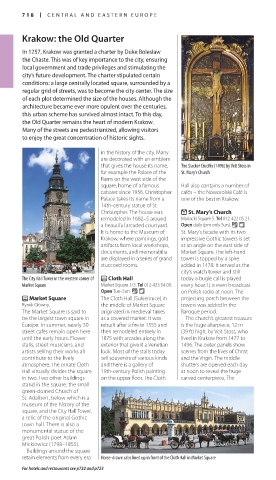
The City Hall Tower in the western corner of P Cloth Hall today a bugle call is played
Market Square Market Square 1/3. Tel 012-433 54 00. every hour. It is even broadcast
Open Tue–Sun. & 8 on Polish radio at noon. The
P Market Square The Cloth Hall (Sukiennice) in projecting porch between the
Rynek Główny. the middle of Market Square towers was added in the
The Market Square is said to originated in medieval times Baroque period.
be the largest town square in as a covered market. It was The church’s greatest treasure
Europe. In summer, nearly 30 rebuilt after a fire in 1555 and is the huge altarpiece, 12 m
street cafés remain open here then remodeled entirely in (39 ft) high, by Veit Stoss, who
until the early hours. Flower 1875 with arcades along the lived in Krakow from 1477 to
stalls, street musicians, and exterior that give it a Venetian 1496. The outer panels show
artists selling their works all look. Most of the stalls today scenes from the lives of Christ
contribute to the lively sell souvenirs of various kinds and the Virgin. The middle
atmosphere. The ornate Cloth and there is a gallery of shutters are opened each day
Hall virtually divides the square 19th-century Polish painting at noon to reveal the huge
in two. Two other buildings on the upper floor. The Cloth carved centerpiece, The
stand in the square: the small
green-domed Church of
St. Adalbert, below which is a
museum of the history of the
square, and the City Hall Tower,
a relic of the original Gothic
town hall. There is also a
monumental statue of the
great Polish poet Adam
Mickiewicz (1798–1855).
Buildings around the square
retain elements from every era Horse-drawn cabs lined up in front of the Cloth Hall in Market Square
For hotels and restaurants see p722 and p723
718-719_EW_Europe.indd 718 14/07/16 10:11 am

