


Page 718 - (DK Eyewitness) Travel Guide - Europe
P. 718
716 CENTR AL AND EASTERN EUROPE
2 Krakow
For nearly six centuries, Krakow was the capital of Poland and
the country’s largest city. Polish rulers resided at Wawel Castle
until the court and parliament moved to Warsaw in 1596.
Even then, Krakow continued to be regarded as the official
capital and rulers were still crowned and buried in the
cathedral on Wawel Hill. The city still plays an important role
in preserving the national identity. The prestigious Jagiellonian Royal Castle
The Birds Hall, with its gilded
University is the oldest in the country and the city is full of coffered ceiling and marble
memorials to illustrious Poles. Perhaps Krakow’s greatest fireplace, is one of the later
attraction lies in the fact that, unlike so many Polish cities, 17th-century rooms in the castle’s
it was scarcely damaged in World War II. In recent years, Royal Apartments.
many buildings and monuments have been restored to
their former glory.
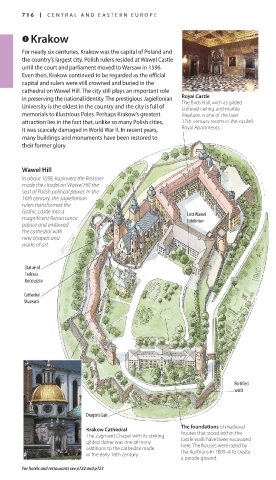
Wawel Hill
In about 1038, Kazimierz the Restorer
made the citadel on Wawel Hill the
seat of Polish political power. In the
16th century, the Jagiellonian
rulers transformed the
Gothic castle into a Lost Wawel
magnificent Renaissance Exhibition
palace and endowed
the cathedral with
new chapels and
works of art.
Statue of
Tadeusz
Kościuszko
Cathedral
Museum
Fortified
walls
Dragon’s Lair
The foundations of medieval
Krakow Cathedral houses that stood within the
The Zygmunt Chapel with its striking castle walls have been excavated
gilded dome was one of many here. The houses were razed by
additions to the cathedral made the Austrians in 1805–6 to create
in the early 16th century.
a parade ground.
For hotels and restaurants see p722 and p723
716-717_EW_Europe.indd 716 14/07/16 10:20 am

