


Page 716 - (DK Eyewitness) Travel Guide - Europe
P. 716
714 CENTR AL AND EASTERN EUROPE
7 Monument to the 8 Monument to
Ghetto Heroes Those Fallen
Pomnik Bohaterów Getta, Zamenhofa. and Murdered in
@ 111, 180. the East
ul. Muranowska. @ 116, 178, 503.
The Nazis created the Jewish v 18, 35.
ghetto in 1940 by driving the
Jewish inhabitants of Warsaw This emotionally stirring
and nearby villages into an area monument, designed by
in the northwest of the city. The Mirosław Biskupski and unveiled
ghetto initially housed around in 1995, takes the form of a
450,000 people, but by 1942, typical railway wagon in which
over 300,000 had been trans Poles were deported into the
ported to death camps, and depths of the Soviet Union.
100,000 others had died or been It is filled with a pile of crosses
killed in the ghetto. The Ghetto symbolizing the hundreds of
Uprising of 1943 was an action thousands of Poles carted off
of heroic defiance against the to the East in cattle vans and The imposing Socialist Realist Palace of
Nazis, planned not as a bid for subsequently murdered in Culture and Science
liberty, but as an honorable way Soviet prison camps.
to die. Built to commemorate 0 National Museum
this action, the Monument to 9 Palace of Culture Aleje Jerozolimskie 3. Tel 22621 10
the Ghetto Heroes stands in the and Science 31. @ 111, 117, 158, 507, 517, 521. v
center of the former ghetto. 7, 9, 22, 24. Open 10am–6pm Tue–
It depicts men, women, and Plac Defilad 1. Tel 22656 76 00. Sun (to 9pm Thu). Closed public hols.
children struggling to flee the Viewing Terrace: Open daily. & & (free Tue). Military Museum: Tel
burning ghetto, together with 022629 52 71. Open 10am–5pm
a procession of Jews being This monolithic building was Wed, 10am–4pm Thu–Sun. Closed
driven to Nazi death camps. a “gift” from Soviet Russia to some public hols. & (free Sat). 8
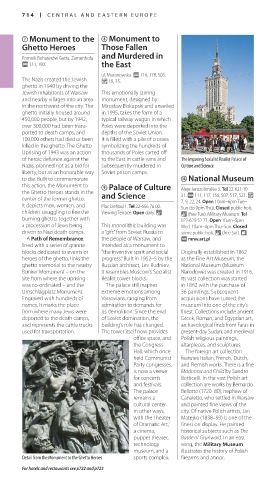
A Path of Remembrance, the people of Warsaw, and ∑ mnw.art.pl
lined with a series of granite intended as a monument to
blocks dedicated to events or “the inventive spirit and social Originally established in 1862
heroes of the ghetto, links the progress.” Built in 1952–5 by the as the Fine Art Museum, the
ghetto memorial to the nearby Russian architect, Lev Rudniev, National Museum (Muzeum
Bunker Monument – on the it resembles Moscow’s Socialist Narodowe) was created in 1916.
site from where the uprising Realist tower blocks. Its vast collection was started
was coordinated – and the The palace still inspires in 1862 with the purchase of
Umschlagplatz Monument. extreme emotions among 36 paintings. Subsequent
Engraved with hundreds of Varsovians, ranging from acquisitions have turned the
names, it marks the place admiration to demands for museum into one of the city’s
from where many Jews were its demolition. Since the end finest. Collections include ancient
deported to the death camps, of Soviet domination, the Greek, Roman, and Egyptian art,
and represents the cattle trucks building’s role has changed. archaeo logical finds from Faras in
used for transportation. The tower itself now provides presentday Sudan, and medieval
office space, and Polish religious paintings,
the Congress altarpieces, and sculptures.
Hall, which once The foreign art collection
held Communist features Italian, French, Dutch,
Party congresses, and Flemish works. There is a fine
is now a venue Madonna and Child by Sandro
for concerts Botticelli. In the vast Polish art
and festivals. collection are works by Bernardo
The palace Bellotto (1720–80), nephew of
remains a Canaletto, who settled in Warsaw
cultural center and painted fine views of the
in other ways, city. Of native Polish artists, Jan
with the Theater Matejko (1838–93) is one of the
of Dramatic Art, finest on display. He painted
a cinema, historical subjects such as The
puppet theater, Battle of Grunwald. In an east
technology wing, the Military Museum
museum, and a illustrates the history of Polish
Detail from the Monument to the Ghetto Heroes sports complex. firearms and armor.
For hotels and restaurants see p722 and p723
714-715_EW_Europe.indd 714 14/07/16 10:20 am

