


Page 40 - How It Works - Book of Amazing Answers To Curious Questions, 12
P. 40
AMAZIG ANSWERS TO CURIOUS QUESTIONS -------------------


        What's in our ears?


         The ear performs a range of functions,
         sending messages to the brain when

         a sound is made while also providing
         your body with a sense of balance
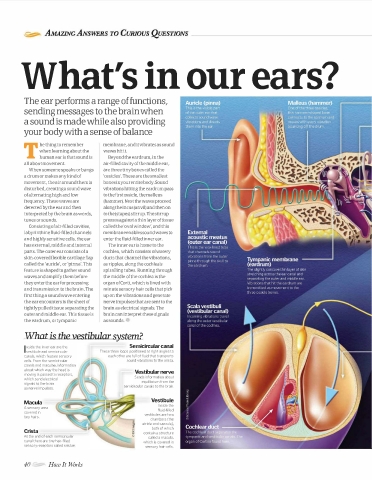
              he thing to remember   membrane, and it vibrates as sound
              when learning about the   waves hit it.
         T  human ear is that sound is   Beyond the eardrum, in the
         all about movement.      air-filled cavity of the middle ear,
          When someone speaks or bangs   are three tiny bones called the
         a drum or makes any kind of   'ossicles'. These are the smallest
         movement, the air around them is   bones in your entire body. Sound
         disturbed, creating a sound wave   vibrations hitting the eardrum pass
         of alternating high and low   to the first ossicle, the malleus
         frequency. These waves are   (hammer). Next the waves proceed
         detected by the ear and then   along the incus (anvil) and then on
         interpreted by the brain as words,   to the (stapes) stirrup. The stirrup
         tunes or sounds.         presses against a thin layer of tissue
          Consisting of air-filled cavities,   called the 'oval window', and this
         labyrinthine fluid-filled channels   membrane enables sound waves to
         and highly sensitive cells, the ear   enter the fluid-filled inner ear.
         has external, middle and internal   The inner ear is home to the
         parts. The outerearconsists of a   cochlea, which consists of watery
         skin-covered flexible cartilage flap   ducts that channel the vibrations,
         called the 'auricle', or 'pinna'. This   as ripples, along the cochlea's
         feature is shaped to gather sound   spiralling tubes. Running through
         waves and amplify them before   the middle of the cochlea is the
         they enter the ear for processing   organ of Corti, which is lined with
         and transmission to the brain. The   minute sensory hair cells that pick
         first thing a sound wave entering   up on the vibrations and generate
         the ear encounters is the sheet of   nerve impulses that are sent to the
         tightly pulled tissue separating the   brain as electrical signals. The
         outer and middle ear. This tissue is   brain can interpret these signals
         the eardrum, or tympanic   as sounds.
         What is the vestar syst?

         nside the inner ear are the      Semicircular canal
         Ivestibule and semicircular   These three loops positioned at right angles to
         canals, which feature sensory   each other are full of fluid that transports
         cells. From the semicircular     sound vibrations to the crista.
         canals and maculae, information
         about which way the head is
         moving is passed to receptors,     Vestibular nerve
         which send electrical              Sends information about
         signals to the brain                 equilibrium from the
         as nerve impulses.              semicircular canals to the brain.
                                                 Vestibule
         Macula
                                                    Inside the
         A sensory area                            fluid·filled
         covered in                            vestibules are two
         tiny hairs.
                                                 chambers (the
                                               utricle and saccule),
                                                  both of which
         Crista                                contain a structure
         At the end of each  semicircular       called a macula,
         canal there are tiny hair-filled      which is covered in
         sensory receptors called cristae.      sensory hair cells.
         40     How It  TtOrks                  WorldMags.net
                                                WorldMags.net

