


Page 52 - How It Works - Book of Amazing Answers To Curious Questions, 12
P. 52
��vu·� �VESTIONS ---------------------------------------------


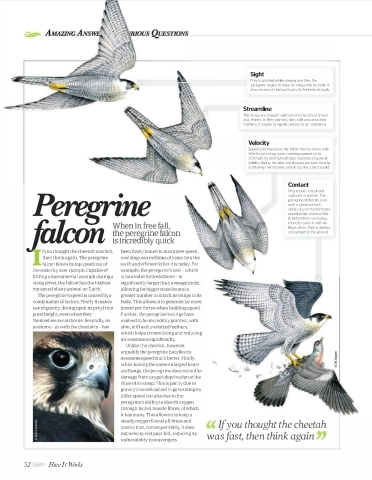
                                                                                 Sight
                                                                                 Prey is spotted while soaring  and then the
                                                                                 peregrine  begins to draw its wings into its body. It
                                                                                 also retracts its tail and tucks its feet into its body.

                                                                               Streamline
                                                                               The wings are brought right into the falcon's sternum
                                                                               and, thanks to their pointed, slim, stiff and unslotted
                                                                               feathers, it begins to rapidly reduce its air resistance.

                                                                                Velocity
                                                                                Speed is increased as the  falcon  bombs down with
                                                                                 little-to-zero drag, soon reaching speeds up to
                                                                                200m ph. Its strong keel helps maintain structural
                                                                                solidity during the dive and its eyes are kept clear by
                                                                                 nictitating membranes, which act like a third eyelid.
                                                                                             Contact
                                                                                             Prey is both  struck and
                                                                                             captured in mid-air. The
                                                                                             peregrine strikes its prey
                                                                                             with a clenched foot,
                                                                                             which due to the immense
                                                                                             speed either stuns or kills
                                                                                             it, before then swooping
         jl)erIJ!efull,                                                                      round to catch it with its
                                                                                             large claws. Prey is always
                                     the peregrine falcon                                    consumed on the ground.
                                     is incredibly quick
               fyou thought the cheetah was fast,   been finely honed to max1m1se speed,
               then think again. The peregrine   evolving over millions of years into the
               falcon blows its top speed out of   swift and efficient killer it is today. For
            the water by over 130mph. Capable of   example, the peregrine's keel -which
            hitting a monumental2oomph during a   is located at its breastbone -is
            stoop (dive), the falcon has the highest   significantly larger than average birds',
            top speed of any animal on Earth.   allowing for bigger muscles and a
             The peregrine's speed is caused by a   greater number to attach its wings to its
            combination of factors. Firstly it makes   body. This allows it to generate far more
            use of gravity, diving upon its prey from   power per thrust when building speed.
           great height, even when they   Further, the peregrine's wings have
            themselves are airborne. Secondly, its   evolved to be incredibly pointed, with
            anatomy- as with the cheetah's - has   slim, stiff and unslotted feathers,
                                        which helps streamlining and reducing
                                        air resistance significantly.
                                         Unlike the cheetah, however,
                                        arguably the peregrine handles its
                                        awesome speed much better. Firstly,
                                        while having the same enlarged heart
                                        and lungs, the peregrine does not suffer
                                        damage from oxygen deprivation at the
                                        close of its stoop. This is partly due to
                                        gravity's beneficial aid in generating its
                                        killer speed but also due to the
                                        peregrine's ability to absorb oxygen
                                        through its red muscle fibres, of which
                                        it has many. This allows it to keep a
                                        steady oxygen flow a tall times and   If you thought the cheetah
                                        means that, consequentially, it does
                                        not need to rest post-kill, reducing its   was fast, then think again
                                        vulnerability to scavengers.


         52     How It TtOrks                   WorldMags.net
                                                WorldMags.net

