


Page 54 - How It Works - Book of Amazing Answers To Curious Questions, 12
P. 54
AMAZIG ANSWERS TO CURIOUS QUESTIONS -------------------
How does a volcano erupt?
Breathtaldng and often devastating reminders that
the Earth's surface is actively evolving
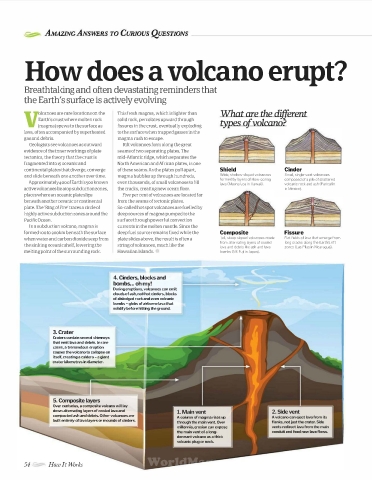
What are the differe
!canoes are rare locations on the This fresh magma, which is lighter than
Earth's crust where molten rock solid rock, percolates upward through
(magma) spews to the surface as fissures in the crust, eventually exploding type ofvoo?
lava, often accompanied by superheated to the surface when trapped gasses in the
gas and debris. magma rush to escape.
Geologists see volcanoes as outward Rift volcanoes form along the great
evidence of the inner workings of plate seams of two separating plates. The
tectonics, the theory that the crust is mid-Atlantic ridge, which separates the
fragmented into 15 oceanic and North American and African plates, is one
continental plates that diverge, converge of these seams. As the plates pull apart, Shield Cinder
and slide beneath one another over time. magma bubbles up through hundreds, Wide, shallow·sloped volcanoes Small, single·vent volcanoes
formed by layers of slow·oozing composed of a pile of shattered
Approximately 400 of Earth's 500 known even thousands, of small volcanoes to fill lava (Mauna Loa in Hawaii). volcanic rock and ash (Paricutin
active volcanoes lie atop subduction zones, the cracks, creating new ocean floor. in Mexico).
places where an oceanic plate slips Five per cent of volcanoes are located far
beneath another oceanic or continental from the seams of tectonic plates.
plate. The 'Ring of fire' traces a circle of So-called hot spot volcanoes are fuelled by
highly active subduction zones around the deep sources of magma pumped to the
Pacific Ocean. surface through powerful convection
In a subduction volcano, magma is currents in the molten mantle. Since the
formed 100 to zookm beneath the surface deep fuel source remains fixed while the Composite Fissure
when water and carbon dioxide seep from plate slides above, the result is often a Tall, steep-sloped volcanoes made Flat fields of lava that emerge from
from alternating layers of cooled long cracks along the Earth's rift
the sinking oceanic shelf, lowering the string of volcanoes, much like the lava and debris like ash and lava zones (Las Pilas in Nicaragua).
melting point of the surrounding rock. Hawaiian Islands. bombs (Mt Fuji in Japan).
4. Cinders, blocks and �
bombs .. . oh my!
During eruptions, volcanoes can emit
clouds of ash, red-hot cinders, blocks
of dislodged rock and even volcanic
bombs - globs of airborne lava that
solidify before hitting the ground.
3. Crater
Craters contain several chimneys
that emit lava and debris. In rare
cases, a tremendous eruption
causes the volcano to collapse on
itself, creating a caldera -a giant
crater kilometres in diameter.
Over centuries, a composite volcano will lay
down alternating layers of cooled lava and
compacted ash and debris. Other volcanoes are A column of magma rises up
buitt entirely of lava layers or mounds of cinders.
through the main vent. Over
millennia, erosion can expose
the main vent of a long
donnant volcano as a thick
54 How It TtOrks WorldMags.net
WorldMags.net

