


Page 55 - How It Works - Book of Amazing Answers To Curious Questions, 12
P. 55
Environment                                                                                Q�
                              _______________


           Why are geysers �n rare?


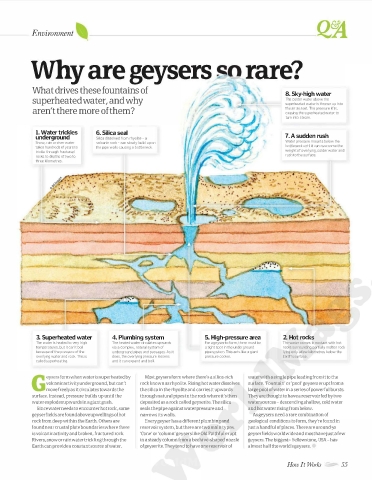
           What drives these fountains of                                                   8. Sky-high water
           superheated water, and why                                                       The colder water above the
                                                                                            superheated water is thrown up into
            aren't there more of them?                                                      the air as a jet. The pressure lifts,
                                                                                            causing the superheated water to
                                                                                            turn  into steam.

            1. Water trickles   6. Silica seal
            underground         Silica dissolved from  rhyolite - a                         7. A sudden rush
            Snow, rain or river water   volcanic rock - can slowly build  up on             Water pressure mounts below the
            takes hundreds of years to   the pipe walls causing a bottleneck.               bottleneck until it  can overcome the
            trickle through fractured                                                       weight of overlying, colder water and
             rocks to depths of two to                                                      rush to the surface.
            three kilometres.


                                                                                       •  .  •  • ;': .  4 •• :


                                                                                                              ..


             3. Superheated water    4. Plumbing system            5. High-pressure area    2. Hot rocks
             The water is  heated to  very  high   The heated water circulates upwards   For a geyser to form, there must be   The water comes in contact with hot
             temperatures, but it can't boil   via a complex, natural system of   a tight spot in the underground   rocks surrounding partially molten rock
             because of the pressure of the   underground pipes and passages. As it   pipe system. This acts like a giant   lying only a few kilometres below the
             overlying water and rock. This is   does, the overlying pressure lessens   pressure cooker.   Earth's surface.
             called superheating.    and it can expand and boil.

                eysers form when water is superheated by   Most geysers form where there's a silica-rich   water with a single pipe leading from it to the
                volcanic activity underground, but can't   rock known as rhyolite. Rising hot water dissolves   surface. 'Fountain' or 'pool' geysers erupt from a
           G  move freely as it circulates towards the   the silica in the rhyolite and carries it upwards   large pool of water in a series of powerful bursts.
           surface. Instead, pressure builds up until the   through natural pipes in the rock where it's then   They are thought to have a reservoir fed by two
           water explodes upwards in a giant gush.   deposited as a rock called geyserite. The silica   water sources- descending shallow, cold water
             Since water needs to encounter hot rock, some   seals the pipe against water pressure and   and hot water rising from below.
           geyser fields are found above upwellings of hot   narrows its walls.   As geysers need a rare combination of
           rock from deep within the Earth. Others are   Every geyser has a different plumbing and   geological conditions to form, they're found in
           found near crustal plate boundaries where there   reservoir system, but there are two main types.   just a handful of places. There are around 50
           is volcanic activity and broken, fractured rock.   'Cone' or 'column' geysers like Old Faithful erupt   geyser fields worldwide and most have just a few
           Rivers, snow or rainwater trick! ing through the   in a steady column from a beehive-shaped nozzle   geysers. The biggest- Yellowstone, USA-has
           Earth can provide a constant source of water.   of geyserite. They tend to have one reservoir of   almost half the world's geysers.


                                                WorldMags.net
                                                WorldMags.net                                How It T%rks     55

