


Page 58 - How It Works - Book of Amazing Answers To Curious Questions, 12
P. 58
AMAZIG ANSWERS TO CURIOUS QUESTIONS -------------------


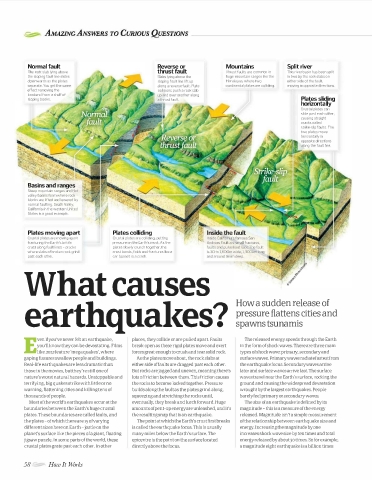
          Nonnal fault                             Reverse or            Mountains           Split river
          The  rock  slab lying above              thrust fault          Thrust faults are common in   This river basin has been split
          the sloping fault line slides            Slabs lying above the   huge mountain ranges like the   in two by the rock slabs on
          downwards as the plates                   sloping fault line lift up   Himalayas, where two   either side of the fault,
          separate. You get the same               along a reverse fault. Plate   continental plates are colliding.   moving in opposite directions.
          effect removing the                       collisions push a rock slab
          bookend from a shelf of                  up and over another along
          sloping books.                           a thrust fault.                               Plates sliding
                                                                                                 horizontally
                                                                                                 Crustal plates can
                                                                                                 slide past each other,
                                                                                                 causing straight
                                                                                                 cracks called
                                                                                                 strike-slip faults. The
                                                                                                 two plates move
                                                                                                 horizontally in
                                                                                                 opposite directions
                                                                                                 along the fault line.


          Basins and ranges
          Steep mountain ranges and flat
          valley basins form where rock
          blocks are lifted and lowered by
          normal faulting. Death Valley,
          California in the western United
          States is a good example.

          Plates moving apart        Plates colliding
          Crustal plates are moving apart   Crustal plates are colliding, putting
          fracturing the Earth's brittle   pressure on the Earth's crust. As the
          crust along fault lines - cracks   plates slowly crunch together, the
          where slabs of broken rock grind   crust bends, folds and fractures like a
          past each other.           car bonnet in a crash.

         What causes


                                                                             How a sudden release of
                                                                             pressure flattens cities and
         earthqual<es?  spawns tsunamis

             ven if you've never felt an earthquake,   places, they collide or are pulled apart. Faults   The released energy speeds through the Earth
             you'll know they can be devastating. Films   break open as these rigid plates move and exert   in the form of shock waves. There are three main
         Elike  2012 feature 'mega quakes', where   forces great enough to crush and tear solid rock.   types of shockwave: primary, secondary and
         gaping fissures swallow people and buildings.   As the plates move about, the rock slabs at   surface waves. Primary waves radiate fastest from
         Real-life earthquakes are less dramatic than   either side of fau Its are dragged past each other.   the earthquake focus. Secondary waves arrive
         those in the movies, but they're still one of   But rocks are jagged and uneven, meaning there's   later and surface waves arrive last. The surface
         nature's worst natural hazards. Unstoppable and   lots of friction between them. This friction causes   waves travel near the Earth's surface, rocking the
         terrifying, big quakes strike with little or no   the rocks to become locked together. Pressure   ground and causing the widespread devastation
         warning, flattening cities and killing tens of   builds along the fault as the plates grind along,   wrought by the largest earthquakes. People
         thousands of people.              squeezing and stretching the rocks until,   barely feel primary or secondary waves.
          Most of the world's earthquakes occur at the   eventually, they break and lurch forward. Huge   The size of an earthquake is defined by its
         boundaries between the Earth's huge crustal   amounts of pent-up energy are unleashed, and it's   magnitude-this is a measure of the energy
         plates. These boundaries are called faults, and   the resulting snap that is an earthquake.   released. Magnitude isn't a simple measurement
         the plates-of which there are 15 of varying   The point at which the Earth's crust first breaks   of the relationship between earthquake size and
         different sizes here on Earth-jostle on the   is called the earthquake focus. This is usually   energy. Increasing the magnitude by one
         planet's surface like the pieces of a giant, floating   many miles below the Earth's surface. The   increases shockwave size by ten times and total
         jigsaw puzzle. In some parts of the world, these   epicentre is the point on the surface located   energy released by about30 times. So for example,
         crustal plates grate past each other. ln other   directly above the focus.   a magnitude eight earthquake is a billion times

         58     How It  TtOrks                  WorldMags.net
                                                WorldMags.net

