


Page 66 - How It Works - Book of Amazing Answers To Curious Questions, 12
P. 66
AMAZIG ANSWERS TO CURIOUS QUESTIONS ------------------


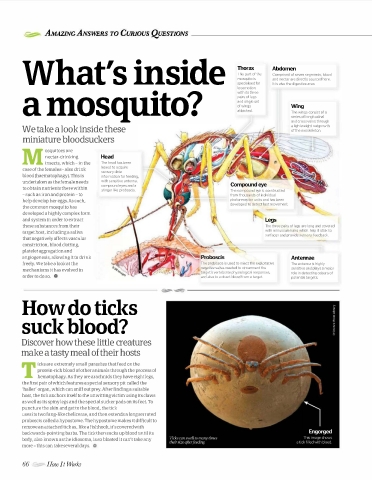
        What's inside                                                        Thorax     Abdomen
                                                                             This  part of the
                                                                                        Comprised of seven segments, blood
                                                                             mosquito is
                                                                                        and nectar are directly sourced here.
                                                                             specialised for
                                                                             locomotion,   It is also the digestive area.
        a mosquito?                                                          pairs of legs    Wing
                                                                             with its three
                                                                             and single set
                                                                             of wings
                                                                             attached.
                                                                                              The wings consist of a
                                                                                              series of longitudinal
                                                                                              and cross veins through
        We take a look inside these                                                           a lightweight outgrowth
                                                                                              of the exoskeleton.
        miniature bloodsud<ers
               osquitoes are
               nectar-drinking   Head
        M  insects, which - in the   The head has been
        case of the females-also drink   honed to acquire
                                 sensory data
        blood lhaematophagy). This is   information for feeding,
        undertaken as the female needs   with sensitive antenna,
                                 compound eyes and a
        to obtain nutrients there within
                                 stinger-like proboscis.                   The compound eye  is  constructed
        -such as iron and protein -to                                      from thousands of individual
        help develop her eggs. As such,                                    photoreceptor units and has been
                                                                           developed to detect fast movement.
        the common mosquito has
        developed a highly complex form
        and system in order to extract                                                Legs
        these substances from their                                                   The three pairs of  legs are long and  covered
        target host, including a saliva                                               with minuscule hairs which  help it stick to
                                                                                      surfaces and provide sensory feedback.
        that negatively affects vascular
        constriction, blood clotting,
        platelet aggregation and
        angiogenesis, allowing it to drink                                                    Antennae
        freely. We take a look at the                            The proboscis is used to inject the exploitative   The antenna is highly
                                                                 negative saliva needed to circumvent the   sensitive and plays a major
        mechanisms it has evolved in
                                                                 1 target's vertebrate physiological responses,   role in detecting odours of
        order to do so.  0                                       and also to extract blood from a target.   potential targets.
                                                     ��      ----------------------------------------------
        How do ticl<s

        sucl< blood?


        Discover how these little creatures
        make a tasty meal of their hosts
             icks are extremely small parasites that feed on the
             protein-rich blood of other animals through the process of
        T  hematophagy. As they are arachnids they have eight legs,
        the first pair of which features a special sensory pit called the
        'hailer' organ, which can sniff out prey. After finding a suitable
        host, the tick anchors itself to the unwitting victim using its claws
        as well as its spiny legs and the special sucker pads on its feet. To
        puncture the skin and get to the blood, the tick
        uses its two fang-like chelicerae, and then extends a long serrated
        proboscis called a hypostome. The hypostome makes it difficult to
        remove an attached tick as, like a fishhook, it's covered with
        backwards-pointing barbs. The tick then sucks up blood until its
        body, also known as the idiosoma, is so bloated it can't take any
        more -this can take several days.  0

        66      How It Works                    WorldMags.net
                                                WorldMags.net

