


Page 110 - (DK Eyewitness) Travel Guide - Brittany
P. 110
108 BRIT T AN Y REGION B Y REGION
f St-Brieuc
The history of St-Brieuc is closely linked to its
evolution as a centre of religion. In the 5th century,
Brioc, a Welsh monk, founded an oratory on the site
of the present Fontaine St-Brieuc, in Rue Notre-Dame.
The city was sacked in the late 16th century, during
the Wars of the Holy League (see p50), although stability
returned in the 17th and 18th centuries. Lying between
the valleys of the Gouédic and the Gouët, St-Brieuc,
capital of the Côtes d’Armor, is a pleasant city. Also a
dynamic centre of culture, it has spawned cultural
organizations and hosts events such as Art Rock
(see p34). It also has associations with several great
French writers.
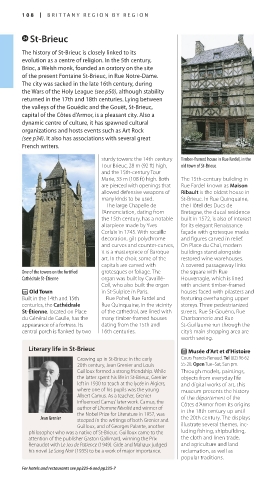
sturdy towers: the 14th-century Timber-framed house in Rue Fardel, in the
Tour Brieuc, 28 m (92 ft) high, old town of St-Brieuc
and the 15th-century Tour
Marie, 33 m (108 ft) high. Both The 15th-century building in
are pierced with openings that Rue Fardel known as Maison
allowed defensive weapons of Ribault is the oldest house in
many kinds to be used. St-Brieuc. In Rue Quinquaine,
The large Chapelle de the Hôtel des Ducs de
l’Annonciation, dating from Bretagne, the ducal residence
the 15th century, has a notable built in 1572, is also of interest
altarpiece made by Yves for its elegant Renaissance
Corlaix in 1745. With rocaille façade with grotesque masks
decoration, gilt polychrome and figures carved in relief.
and curves and counter-curves, On Place du Chai, modern
it is a masterpiece of Baroque buildings stand alongside
art. In the choir, some of the restored wine ware houses.
capitals are carved with A covered passageway links
One of the towers on the fortified grotesques or foliage. The the square with Rue
Cathédrale St-Étienne organ was built by Cavaillé- Houvenagle, which is lined
Coll, who also built the organ with ancient timber-framed
P Old Town in St-Sulpice in Paris. houses faced with pilasters and
Built in the 14th and 15th Rue Pohel, Rue Fardel and featuring overhanging upper
centuries, the Cathédrale Rue Quinquaine, in the vicinity storeys. Three pedestrianized
St-Étienne, located on Place of the cathedral, are lined with streets, Rue St-Gouéno, Rue
du Général de Gaulle, has the many timber-framed houses Charbonnerie and Rue
appearance of a fortress. Its dating from the 15th and St-Guillaume run through the
central porch is flanked by two 16th centuries. city’s main shopping area are
worth seeing.
Literary life in St-Brieuc E Musée d’Art et d’Histoire
Growing up in St-Brieuc in the early Cours Francis-Renaud. Tel (02) 96 62
20th century, Jean Grenier and Louis 55 20. Open Tue–Sat, Sun pm.
Guilloux formed a strong friendship. While Through models, paintings,
the latter spent his life in St-Brieuc, Grenier objects from everyday life
left in 1930 to teach at the lycée in Algiers, and digital works of art, this
where one of his pupils was the young museum presents the history
Albert Camus. As a teacher, Grenier of the département of the
influenced Camus’ later work. Camus, the Côtes d’Armor from its origins
author of L’homme Révolté and winner of in the 18th century up until
the Nobel Prize for Literature in 1957, was
Jean Grenier steeped in the writings of both Grenier and the 20th century. The displays
Guilloux, and of Georges Palante, another illustrate several themes, inc-
philosopher who was a native of St-Brieuc. Guilloux came to the luding fishing, shipbuilding,
attention of the publisher Gaston Gallimard, winning the Prix the cloth and linen trade,
Renaudot with Le Jeu de Patience (1949). Gide and Malraux judged and agriculture and land
his novel Le Sang Noir (1935) to be a work of major importance. reclamation, as well as
popular traditions.
For hotels and restaurants see pp225-6 and pp235-7
108-109_EW_Brittany.indd 108 11/3/16 1:02 PM

