


Page 112 - (DK Eyewitness) Travel Guide - Brittany
P. 112
110 BRIT T AN Y REGION B Y REGION
j Lamballe
Road map D2. £ Boulevard Jobert.
@ * 11,200. n Place du Champ
du Foire; (02) 96 31 05 38. ( Thu.
_ Foire des Potiers (May); Pardon
de Notre-Dame (Sep); National de
Cheval Breton (Sep). ∑ lamballe-
tourisme.com
Founded in the sixth century,
Lamballe began to develop
in the 11th century. Capital
of the duchy of Penthièvre,
the region was one of the
most important strongholds
of Brittany. Until the 18th
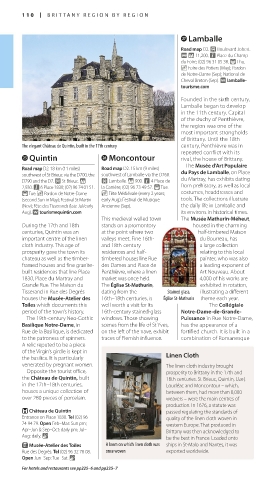
The elegant Château de Quintin, built in the 17th century century, Penthièvre was in
repeated conflict with its
g Quintin h Moncontour rival, the house of Brittany.
The Musée d’Art Populaire
Road map D2. 18 km (11 miles) Road map D2. 15 km (9 miles)
southwest of St-Brieuc via the D700, the southwest of Lamballe via the D768. du Pays de Lamballe, on Place
D790 and the D7. £ St-Brieuc. * £ Lamballe. * 900. n 4 Place de du Martray, has exhibits dating
2,930. n 6 Place 1830; (02) 96 74 01 51. la Carrière; (02) 96 73 49 57. ( Tue. from prehistory, as well as local
( Tue. _ Pardon de Notre-Dame _ Fête Médiévale (every 2 years; costumes, headdresses and
(second Sun in May); Festival St Martin early Aug); Festival de Musique tools. The collections illustrate
(Nov); Fête des Tisserands (late Jul/early Ancienne (Sep). the daily life in Lamballe and
Aug). ∑ tourismequintin.com its environs in historical times.
This medieval walled town The Musée Mathurin-Méheut,
During the 17th and 18th stands on a promontory housed in the charming
centuries, Quintin was an at the point where two half-timbered Maison
important centre of the linen valleys meet. Fine 16th- du Bourreau, has
cloth industry. This age of and 18th-century a large collection
prosperity gave the town its residences and half- relating to this local
chateau as well as the timber- timbered houses line Rue painter, who was also
framed houses and fine granite- des Dames and Place de a leading exponent of
built residences that line Place Penthièvre, where a linen Art Nouveau. About
1830, Place du Martray and market was once held. 4,000 of his works are
Grande Rue. The Maison du The Église St-Mathurin, exhibited in rotation,
Tisserand in Rue des Degrés dating from the Stained glass, illustrating a different
houses the Musée-Atelier des 16th–18th centuries, is Église St-Mathurin theme each year.
Toiles which documents this well worth a visit for its The Collégiale
period of the town’s history. 16th-century stained-glass Notre-Dame-de-Grande-
The 19th-century Neo-Gothic windows. Those showing Puissance in Rue Notre-Dame,
Basilique Notre-Dame, in scenes from the life of St Yves, has the appearance of a
Rue de la Basilique, is dedicated on the left of the nave, exhibit fortified church. It is built in a
to the patroness of spinners. traces of Flemish influence. combination of Romanesque
A relic reputed to be a piece
of the Virgin’s girdle is kept in
the basilica. It is particularly Linen Cloth
venerated by pregnant women. The linen cloth industry brought
Opposite the tourist office, prosperity to Brittany in the 17th and
the Château de Quintin, built 18th centuries. St-Brieuc, Quintin, Uzel,
in the 17th–18th centuries, Loudéac and Moncontour – which,
houses a unique collection of between them, had more than 8,000
over 280 pieces of porcelain. weavers – were the main centres of
production. In 1676, a statute was
+ Château de Quintin passed regulating the standards of
Entrance on Place 1830. Tel (02) 96 quality of the linen cloth woven in
74 94 79. Open Feb–Mar: Sun pm; western Europe. That produced in
Apr–Jun & Sep–Oct: daily pm; Jul– Brittany was then acknowledged to
Aug: daily. & be the best in France. Loaded onto
E Musée-Atelier des Toiles A loom on which linen cloth was ships in St-Malo and Nantes, it was
Rue des Degrés. Tel (02) 96 32 78 08. once woven exported worldwide.
Open Jun–Sep: Tue–Sat. &
For hotels and restaurants see pp225–6 and pp235–7
110-111_EW_Brittany.indd 110 11/3/16 12:42 PM

