


Page 164 - (DK Eyewitness) Travel Guide - Brittany
P. 164
162 BRIT T AN Y REGION B Y REGION
Joseph Astor assembled
a collection of 16th- to
20th-century paintings and
drawings, and a large collection
of faience from the former
faience factory at Porquier.
These now form part of a
museum collection which also
includes some pieces of
traditional Breton furniture.
s Pont-l’Abbé
Road map B3. * 8,425. k
Quimper-Cornouaille. £ Quimper.
@ n 11 Place Gambetta; (02) 98 82
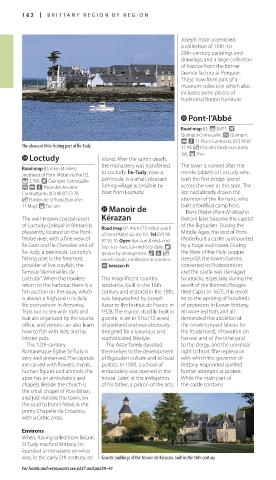
The pleasant little fishing port of Île-Tudy 37 99. _ Fête des Brodeuses (early
p Loctudy island. After the saint’s death, Jul). ( Thu.
the monastery was transferred The town is named after the
Road map B3. 6 km (4 miles)
southeast of Pont-l’Abbé via the D2. to Loctudy. Île-Tudy, now a monks (abbés) of Loctudy who
* 3,700. k Quimper-Cornouaille. peninsula, is a small, pleasant built the first bridge (pont)
£ @ n Place des Anciens- fishing village accessible by across the river at this spot. The
Combattants; (02) 98 87 53 78. boat from Loctudy. site had already drawn the
_ Pardon de St-Tudy (Sun after attention of the Romans, who
11 May). ( Tue am. built a fortified camp here.
a Manoir de Pont-l’Abbé (Pont-N’-Abad in
The well-known coastal resort Kérazan Breton) later became the capital
of Loctudy (Loktudi in Breton) is Road map B2. 4 km (2.5 miles) south of the Bigouden. During the
pleasantly located on the Pont- of Pont-l’Abbé via the D2. Tel (02) 98 Middle Ages, the lord of Pont-
l’Abbé river, with a fine view of 87 50 10. Open Apr–Jun & mid–end l’Abbé built a castle surmounted
Île Garo and Île Chevalier and of Sep: Tue–Sun; Jul–mid-Sep: daily. 8 by a huge oval tower. During
Île-Tudy, a peninsula. Loctudy’s groups by arrangement. & 7 _ the Wars of the Holy League
fishing port is the foremost mini-festivals, exhibitions in summer. (see p50), the town’s barons
provider of live crayfish, the ∑ kerazan.fr converted to Protestantism,
famous “demoiselles de and the castle was damaged
Loctudy”. When the trawlers This magnificent country by attacks, especially during the
return to the harbour, there is a residence, built in the 16th revolt of the Bonnets Rouges
fish auction on the quay, which century and restored in the 18th, (Red Caps). In 1675, this revolt
is always a high point in daily was bequeathed by Joseph let to the uprising of hundreds
life everywhere in Armorica. Astor to the Institut de France in of protestors in Lower Brittany.
Trips out to sea with rods and 1928. The manor, sturdily built in All wore red hats and all
bait are organized by the tourist granite, is set in 5 ha (12 acres) demanded the abolition of
office, and visitors can also learn of parkland and was obviously the corvée (unpaid labour for
how to fish with nets and lay designed for a luxurious and the feudal lord), of taxation on
lobster pots. sophisticated lifestyle. harvest and of the tithe paid
The 12th-century The Astor family devoted to the clergy, and the universal
Romanesque Église St-Tudy is themselves to the develop ment right to hunt. The repression
very well preserved. The capitals of Bigouden culture and to local with which the governor of
are carved with flowers, masks, politics. In 1930, a school of Brittany responded quelled
human figures and animals; the embroidery was opened in the further attempts at protest.
apse has an ambulatory and house. Later, at the instigation While the main part of
chapels. Beside the church is of his father, a patron of the arts, the castle contains
the small chapel of Pors-Bihan,
and just outside the town, on
the road to Pont-l’Abbé, is the
pretty Chapelle de Croaziou,
with a Celtic cross.
Environs
When, having sailed from Britain,
St Tudy reached Brittany, he
founded a monastery on what
was, in the early 5th century, an Granite buildings of the Manoir de Kérazan, built in the 16th century
For hotels and restaurants see p227 and pp239–41
162-163_EW_Brittany.indd 162 11/3/16 12:48 PM

