


Page 163 - (DK Eyewitness) Travel Guide - Brittany
P. 163
SOUTHERN FINISTÈRE 161
carved in granite from Scaër.
This stone is prone to becoming General de Gaulle’s Call to Arms
covered in lichen, as can be The harsh existence that
seen in The Last Judgment and generations of Sénans
The Last Supper (on the south (inhabitants of the Île de Sein)
side). The Visitation, The Nativity had endured gave them a
and The Three Kings bringing fighting spirit. When, on 18 June
their gifts (north side) are 1940, General de Gaulle made his
carved in tougher kersanton appeal by radio from London,
(black granite). calling on all Frenchmen to fight
the German invasion, the men of
Sein readily left the island to join
other volunteers in England.
When the Germans reached Sein,
the only people left were women
and children. In July 1940, the
leader of Free France reviewed
the first 600 volunteers, 150 of
whom were Sénans. “The Île de General de Gaulle with seamen on the
Sein therefore represents a Île de Sein
quarter of France,” exclaimed the
general. Of the Sénan seamen who answered the call, only
114 returned. In 1946, de Gaulle came to the island to award
it the Croix de la Libération.
(30 miles). The Musée de la This fishing village began to
The elegant belfry on the church of Préhistoire, near the Plage develop in the 19th century
Notre-Dame-de-Tronoën de Pors-Carn, documents the when it became Quimper’s
region’s prehistory. main supplier of fresh fish.
Today, Le Guilvinec is still a
i Penmarc’h Phare d’Eckmühl large, traditional fishing village.
Tel (06) 07 21 37 34. Open Apr–Sep: The quayside comes to life in
Road map B3. 12 km (7.5 miles)
southwest of Pont-l’Abbé via the daily; Oct–Nov: pm daily (weather- the late after noon when the
D785. k Quimper-Cornouaille. £ dependent; phone to check). & boats return. Haliotika, a sea-
@ * 6,030. n Place du Maréchal- E Musée de la Préhistoire fishing discovery centre, can
Davout; (02) 98 58 81 44. _ Pardon Rue du Musée-Préhistorique. also be found here, with
de Notre-Dame-de-la-Joie (15 Aug). Tel (02) 98 58 60 35. Open Jun–Sep: exciting interactive exhibits.
( Jun–Sep: Fri am (St-Guénolé daily. 8 & A seaweed oven at Pointe du
harbour) & Wed (Kérity harbour). Men-Meur bears witness to the
∑ penmarch.fr importance of seaweed-
o Le Guilvinec harvesting in the past. Further
The story goes that the cruel Road map B3. 10 km (6 miles) south on is the Manoir de Kergoz, an
Princess Dahud cast a spell of Pont-l’Abbé via the D785 and D57. attractive manor built in the
on Marc’h, legendary king * 3,040. k Quimper-Cornouaille. 15th century and now restored.
of Poulmarc’h, as the result of £ @ n Rue de Men Crenn; (02) 98 It has a 16th-century dovecote.
which his head was turned into 58 29 29. _ Les Estivales Jul–Aug: Fri. Footpaths lead to Lesconil, a
that of a horse (penmarc’h). ( Tue & Sun (summer). charming fishing village with
Penmarc’h consists of three ∑ leguilvinec.com white houses.
parishes: that of Penmarc’h
itself, and those of St-Guénolé
and Kérity. St-Guénolé is
the second-largest port in the
Bigouden and the sixth-largest
in France. The computerized fish
auction that is held there is the
most advanced in Europe.
The Phare d’Eckmühl is the
pride of the town. Built in 1897
with funds provided by the
daughter of Général Davout,
Prince of Eckmühl, the
lighthouse is made of Breton
granite known as kersanton.
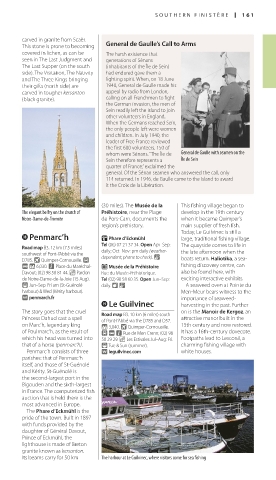
Its beams carry for 50 km The harbour at Le Guilvinec, where visitors come for sea fishing
160-161_EW_Brittany.indd 161 11/3/16 1:03 PM

