


Page 186 - (DK Eyewitness) Travel Guide - Brittany
P. 186
184 BRIT T AN Y REGION B Y REGION
8 Carnac Chalcolithic and the appearance
of the earliest bronze tools,
Brittany’s best-known prehistoric site is, without doubt, Carnac. the Bronze Age (1800–750 BC),
The alignments of 3,000 standing stones – which may originally the Iron Age, and the Gallo-
have numbered over 6,000 – are the most extraordinary group Roman period, which is fittingly
of menhirs in the world. The oldest date from the Neolithic illustrated by objects found at the
Villa des Bosséno, near Carnac.
period and the most recent from the Bronze Age. Although
their significance remains unknown, they were probably Alignements de Kerzérho
connected to religion. Apart from its famous megaliths, Carnac Along the D781 heading north from
also has wide sandy beaches and a lively commercial centre, Carnac to Lorient, just before arriving
at Erdeven. Tel (02) 97 55 64 60.
making it a popular coastal resort for summer visitors. Open daily. 8 arranged at tourist
office, 7 Rue Abbé Le Barh, Erdeven.
These alignments are made up
of 1,130 menhirs arranged east
to west in 11 rows. A line
consisting of 29 menhirs,
perpendicular to the west, has
two stones over 4 m (13 ft) high.
These standing stones are
known locally as the “Soldiers
of St Cornely”, and the location
“Caesar’s Camp”, recalling
Erdeven’s history, from Roman
occupation to Christian times.
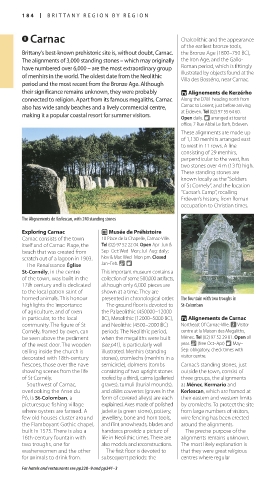
The Alignements de Kerlescan, with 240 standing stones
Exploring Carnac E Musée de Préhistoire
Carnac consists of the town 10 Place de la Chapelle, Carnac-Ville.
itself and of Carnac-Plage, the Tel (02) 97 52 22 04. Open Apr–Jun &
beach that was created from Sep–Oct: Wed–Mon; Jul–Aug: daily;
scratch out of a lagoon in 1903. Nov & Mar: Wed–Mon pm. Closed
The Renaissance Église Jan–Feb. & 8
St-Cornély, in the centre This important museum contains a
of the town, was built in the collection of some 500,000 artifacts,
17th century and is dedicated although only 6,000 pieces are
to the local patron saint of shown at a time. They are
horned animals. This honour presented in chronological order. The fountain with two troughs in
highlights the importance The ground floor is devoted to St-Colomban
of agriculture, and of oxen the Palaeolithic (450000–12000
in particular, to the local BC), Mesolithic (12000–5000 BC), Alignements de Carnac
community. The figure of St and Neolithic (4500–2000 BC) Northeast Of Carnac-Ville. n Visitor
Cornély, framed by oxen, can periods. The Neolithic period, centre at la Maison des Megaliths,
be seen above the pediment when the megaliths were built Ménec. Tel (02) 97 52 29 81. Open all
of the west door. The wooden (see p41), is particularly well year. & (free Oct–Apr) 8 May–
ceiling inside the church is illustrated. Menhirs (standing Sep: obligatory, check times with
decorated with 18th-century stones), cromlechs (menhirs in a visitor centre.
frescoes, those over the nave semicircle), dolmens (tombs Carnac’s standing stones, just
showing scenes from the life consisting of two upright stones outside the town, consist of
of St Cornély. roofed by a third), cairns (galleried three groups, the alignments
Southwest of Carnac, graves), tumuli (burial mounds), at Ménec, Kermario and
overlooking the Anse du and allées couvertes (graves in the Kerlescan, which are framed at
Pô, is St-Colomban, a form of covered alleys) are each their eastern and western limits
picturesque fishing village explained. Axes made of polished by cromlechs. To protect the site
where oysters are farmed. A jadeite (a green stone), pottery, from large numbers of visitors,
few old houses cluster around jewellery, bone and horn tools, wire fencing has been erected
the Flamboyant Gothic chapel, and flint arrowheads, blades and around the alignments.
built in 1575. There is also a handaxes provide a picture of The precise purpose of the
16th-century fountain with life in Neolithic times. There are alignments remains unknown.
two troughs, one for also models and reconstructions. The most likely explanation is
washerwomen and the other The first floor is devoted to that they were great religious
for animals to drink from. subsequent periods: the centres where regular
For hotels and restaurants see pp228–9 and pp241–3
184-185_EW_Brittany.indd 184 11/3/16 1:03 PM

