


Page 35 - (DK Eyewitness) Travel Guide - Brittany
P. 35
A POR TR AIT OF BRIT T AN Y 33
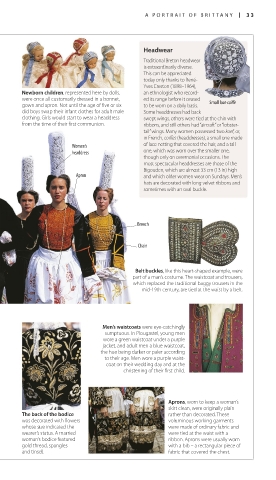
Headwear
Traditional Breton head wear
is extraordinarily diverse.
This can be appreciated
today only thanks to René-
Yves Creston (1898–1964),
Newborn children, represented here by dolls, an ethnologist who record-
were once all customarily dressed in a bonnet, ed its range before it ceased Small lace coiffe
gown and apron. Not until the age of five or six to be worn on a daily basis.
did boys swap their infant clothes for adult male Some head dresses had back-
clothing. Girls would start to wear a head dress swept wings, others were tied at the chin with
from the time of their first communion. ribbons, and still others had “aircraft” or “lobster-
tail” wings. Many women pos sessed two koef, or,
in French, coiffes (headdresses), a small one made
Women’s of lace netting that covered the hair, and a tall
headdress one, which was worn over the smaller one,
though only on ceremonial occa sions. The
most spectacular headdresses are those of the
Bigouden, which are almost 33 cm (13 in) high
Apron and which older women wear on Sundays. Men’s
hats are decorated with long velvet ribbons and
sometimes with an oval buckle.
Brooch
Chain
Belt buckles, like this heart-shaped example, were
part of a man’s costume. The waistcoat and trousers,
which replaced the traditional baggy trousers in the
mid-19th century, are tied at the waist by a belt.
Men’s waistcoats were eye-catchingly
sumptuous. In Plougastel, young men
wore a green waistcoat under a purple
jacket, and adult men a blue waistcoat,
the hue being darker or paler according
to their age. Men wore a purple waist-
coat on their wedding day and at the
christening of their first child.
Aprons, worn to keep a woman’s
skirt clean, were originally plain
The back of the bodice rather than decorated. These
was decorated with flowers voluminous working garments
whose size indicated the were made of ordinary fabric and
wear er’s status. A married were tied at the waist with a
woman’s bodice featured ribbon. Aprons were usually worn
gold thread, spangles with a bib – a rectangular piece of
and tinsel. fabric that covered the chest.
032-033_EW_Brittany.indd 33 11/3/16 1:02 PM

