


Page 30 - (DK Eyewitness) Travel Guide - Brittany
P. 30
28 INTRODUCING BRIT T AN Y
Breton Music
As it continues to grow in popularity, Breton music goes from
strength to strength. In the 1990s, L’Héritage des Celtes and
Again, two of Alan Stivell’s albums, sold in their thou sands,
the instrumentalist Dan Ar Braz has twice been awarded the
prestigious Victoire de la Musique, and the techno specialist Denez
Prigent has won critical acclaim. In Brittany, music is a central
aspect of popular culture. Almost 70 per cent of French traditional
musicians are Bretons, and in Brittany new music venues open at
a faster rate than anywhere else in France. Celtic heritage lives on.
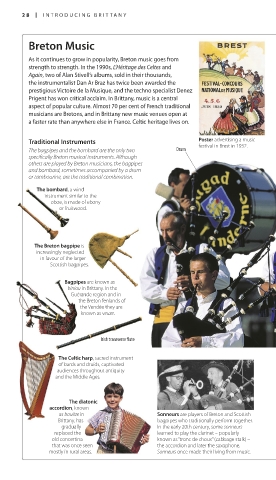
Traditional Instruments Poster advertising a music
festival in Brest in 1932.
The bagpipes and the bombard are the only two Drum
specifically Breton musical instruments. Although
others are played by Breton musicians, the bagpipes
and bombard, sometimes accompanied by a drum
or tambourine, are the traditional combination.
The bombard, a wind
instrument similar to the
oboe, is made of ebony
or fruitwood.
The Breton bagpipe is
increasingly neglected
in favour of the larger
Scottish bagpipes.
Bagpipes are known as
biniou in Brittany. In the
Guérande region and in
the Breton fenlands of
the Vendée they are
known as veuze.
Irish transverse flute
The Celtic harp, sacred instru ment
of bards and druids, captivated
audiences throughout antiquity
and the Middle Ages.
The diatonic
accordion, known
as bouëze in Sonneurs are players of Breton and Scottish
Brittany, has bagpipes who traditionally perform together.
gradually In the early 20th century, some sonneurs
replaced the learned to play the clarinet – popularly
old concertina known as “tronc de choux” (cabbage stalk) –
that was once seen the accordion and later the saxophone.
mostly in rural areas. Sonneurs once made their living from music.
028-029_EW_Brittany.indd 28 11/3/16 1:02 PM

