


Page 40 - (DK Eyewitness) Travel Guide - Brittany
P. 40
38 INTRODUCING BRIT T AN Y
Pardons and Festou-noz
The term pardon dates from the Middle Ages, when popes
granted indulgences (remissions of punishment for sin) to
worshippers who came to church. The annual pardon later
became a day of worship honouring a local patron saint, with
a procession and pilgrimage. In rural areas, a large number of
saints were venerated, and here, minor pardons have evolved
into occasions when communities join together to celebrate.
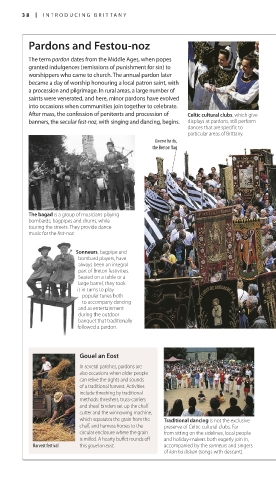
After mass, the confession of penitents and procession of Celtic cultural clubs, which give
banners, the secular fest-noz, with singing and dancing, begins. displays at pardons, still perform
dances that are specific to
particular areas of Brittany.
Gwenn ha du,
the Breton flag
The bagad is a group of musicians playing
bombards, bagpipes and drums, while
touring the streets. They provide dance
music for the fest-noz.
Sonneurs, bagpipe and
bombard players, have
always been an integral
part of Breton festivities.
Seated on a table or a
large barrel, they took
it in turns to play
popular tunes both
to accompany dancing
and as entertainment
during the outdoor
banquet that tradi tionally
followed a pardon.
Gouel an Eost
In several parishes, pardons are
also occasions when older people
can relive the sights and sounds
of a traditional harvest. Activities
include threshing by traditional
methods: threshers, truss-carriers
and sheaf-binders set up the chaff-
cutter and the winnowing machine,
which separates the grain from the Traditional dancing is not the exclusive
chaff, and har ness horses to the preserve of Celtic cultural clubs. Far
circular enclosure where the grain from sitting on the sidelines, local people
is milled. A hearty buffet rounds off and holiday-makers both eagerly join in,
Harvest festival this gouel an eost. accompanied by the sonneurs and singers
of kan ha diskan (songs with descant).
038-039_EW_Brittany.indd 38 11/3/16 1:02 PM

